Scythians were Iranian-speaking peoples associated with the Eurasian steppe during the first millennium BCE. “Scythian” sometimes refers narrowly to groups north of the Black Sea and sometimes more broadly to related archaeological cultures. Religious evidence must be located within those different usages.

Herodotus's fifth-century BCE account is the fullest surviving narrative source for the Black Sea Scythians. He records names and stories while explaining them through Greek categories. Archaeology provides a separate body of evidence, especially through burial mounds and objects.
The Named Gods
Herodotus identifies Tabiti with Hestia, the Greek hearth goddess, and gives her a particularly important position. The comparison points toward the religious significance of fire, but does not supply a complete Scythian myth about her.
Papaios is compared with Zeus and Api with Earth. Their pairing situates divine ancestry within a relationship between heavenly and terrestrial powers. Goitosyros is compared with Apollo, Argimpasa or Artimpasa with Heavenly Aphrodite, and Thagimasadas with Poseidon, particularly among the Royal Scythians.
These comparisons are evidence of translation. They do not establish that Scythians told the Greek stories of Zeus's affairs or Poseidon's quarrels under different names. Herodotus also mentions powers he calls Heracles and Ares without supplying indigenous names in the same list. Herodotus, Histories, book 4.
Targitaos and the Golden Objects
One origin account begins with Targitaos, whose parents Herodotus identifies as Zeus and a daughter of the river Borysthenes. Targitaos has three sons. Golden objects—a plough, yoke, axe, and cup—fall from the sky.
When the older brothers approach, the gold blazes and prevents them from taking it. The youngest, Colaxais, can handle the objects and receives royal authority. The story joins kingship with a divine test and with implements connected to production, force, and ceremonial drinking.
The sacred gold is guarded and honoured. Its role is not simply decorative wealth: possession establishes a relationship between the ruler, the people, and the supernatural origin of legitimate authority.
Heracles and the Serpent Woman
Herodotus also records a story told by Greeks living near the Black Sea. Heracles encounters a being with a woman's upper body and a serpent-like lower body after losing his horses. Their union produces sons, and the successful handling of the hero's bow determines which one remains to rule.
This narrative overlaps with the theme of a youngest son proving fitness for authority, but it belongs to a different account with a different setting and narrator. Combining it with Targitaos's story into one seamless genealogy would conceal that distinction. Herodotus, book 4, translated by G. C. Macaulay.
The Sword as a Divine Focus
Herodotus describes a cult in which an old iron sword stood upon a large construction of brushwood. He identifies the recipient as Ares. Animal offerings and human sacrifice are included in his description.
The sword makes martial force materially present without requiring a human-shaped statue. Yet the reported practices should be attributed to Herodotus rather than presented as if every detail had been independently verified in every Scythian territory. His account combines information, observation, comparison, and narrative purposes.
Divination, Oaths, and Royal Well-being
Diviners interpreted bundles of rods, and Herodotus describes another group, the Enarees, using a different procedure. Their distinctive gender presentation and religious status appear through a Greek author's explanatory framework. It is inappropriate to force them directly into a modern identity category or to repeat hostile ancient descriptions as neutral fact.
Oaths and the king's well-being had major religious consequences. Herodotus connects accusations of false swearing with illness and judicial danger. The sacred character of an oath linked personal speech to collective order, making deception more than a private moral failing.
Funerals and the Dead
Royal burial involved elaborate treatment of the deceased and the deposition of possessions and attendants in Herodotus's account. Archaeological kurgans confirm the importance of monumental burial and, in some settings, the killing and burial of people and horses. Individual sites differ greatly in date, wealth, and practice.
Gold ornaments, weapons, vessels, textiles, and animal remains reveal investment in the dead and in the social standing of the living who conducted the funeral. They do not establish one uniform belief about the soul or a complete map of an afterlife.
Animals and the Limits of Interpretation
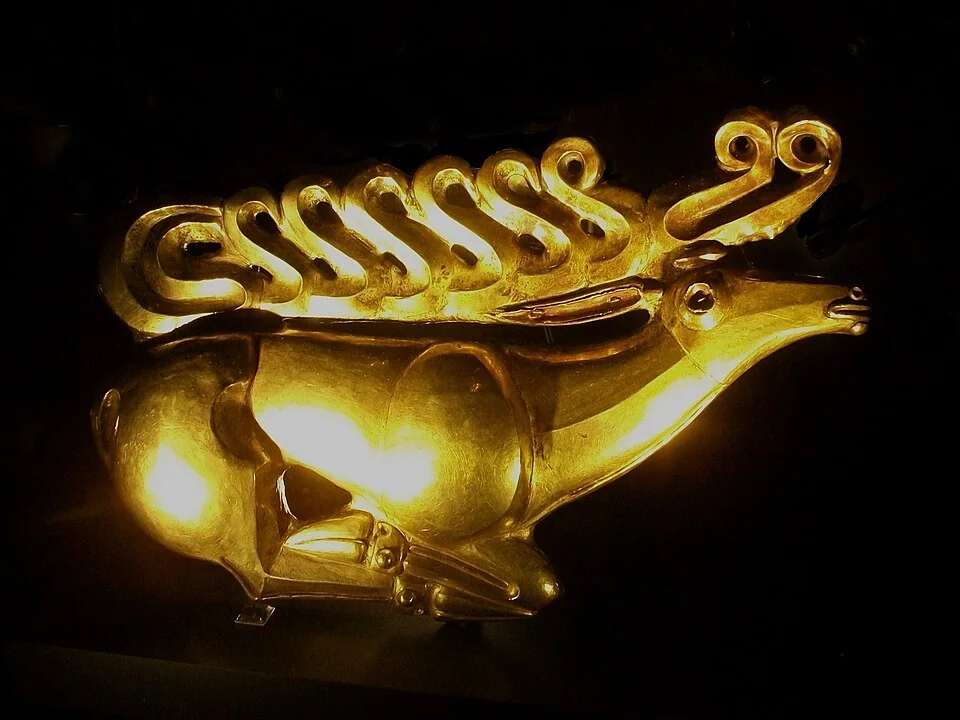
Scythian art often depicts deer, felines, birds, and composite or struggling animals. Their forms can combine observation with deliberate transformation. They may have communicated protection, status, ancestry, or sacred relationships, but the relevant stories seldom survive in a form that securely identifies each image.
Later Sarmatian and Ossetian traditions provide historical comparisons. Linguistic and cultural connections are important, but a later hero or deity cannot be inserted into Herodotus's account without evidence for the proposed continuity.