“Sarmatian” is a collective historical label for Iranian-speaking groups of the Eurasian steppe, including peoples known to Greek and Roman writers as the Iazyges, Roxolani, and others. Their distribution and political relationships changed over centuries. The Alans belong to the later history of this broad world, but an account of one Alan practice cannot describe every earlier Sarmatian community.

No surviving Sarmatian religious literature provides a securely recoverable pantheon. Archaeological evidence and outside descriptions permit discussion of particular practices, while leaving much mythology unknown.
Swords and Sacred Authority
The Roman historian Ammianus Marcellinus describes Alans honouring an upright sword as a divine focus. He interprets it through the Roman war god Mars. The passage indicates a relationship between martial power and worship, but “Mars” is the author's comparison rather than a securely recorded indigenous divine name.
Ammianus also describes divination with twigs. His account was written in the fourth century CE and contains the assumptions and stereotypes of an outside observer. It should neither be dismissed completely nor treated as an exhaustive statement of Alan religion. Ammianus, Roman History, book 31.
Archaeological objects interpreted as amuletic sword hangers provide another kind of evidence. The Hajdúsági Museum relates such objects to a Sarmatian sword cult. Their placement and use suggest that weapons could carry significance beyond their practical function. Hajdúsági Museum, Sarmatian finds.
Burials and the Continuing Person
Graves preserve clothing ornaments, vessels, weapons, jewellery, and other possessions. Their selection and placement indicate that burial was a deliberate social and ritual act. Richly furnished graves also display differences in status and access to resources.
These objects do not automatically prove one specific afterlife doctrine. A vessel may concern provisioning, a funerary meal, or another practice; a weapon may express identity as well as a belief about its use after death. Interpretation is strongest when repeated patterns and archaeological context support it.
The National Museum of History of Moldova's publication on the Petrești cemetery-shrine documents a particular regional complex rather than assuming all Sarmatian funerals were identical. Petrești cemetery-shrine research.
Women and Ritual Roles
Some richly furnished women's burials have been interpreted as those of ritual specialists or priestesses. The Pushkin Museum's research on a burial costume from the Filippovka mounds examines rare embroidered textiles and their reconstruction.
“Priestess” is an archaeological interpretation, not a title preserved in an accompanying autobiography. The assemblage can support arguments about distinction and ritual importance without proving that every high-status woman performed the same religious office. Likewise, a woman's burial with weapons does not by itself establish all the details of her life. Pushkin Museum, Sarmatian burial costume.
Animals, Ornament, and Exchange
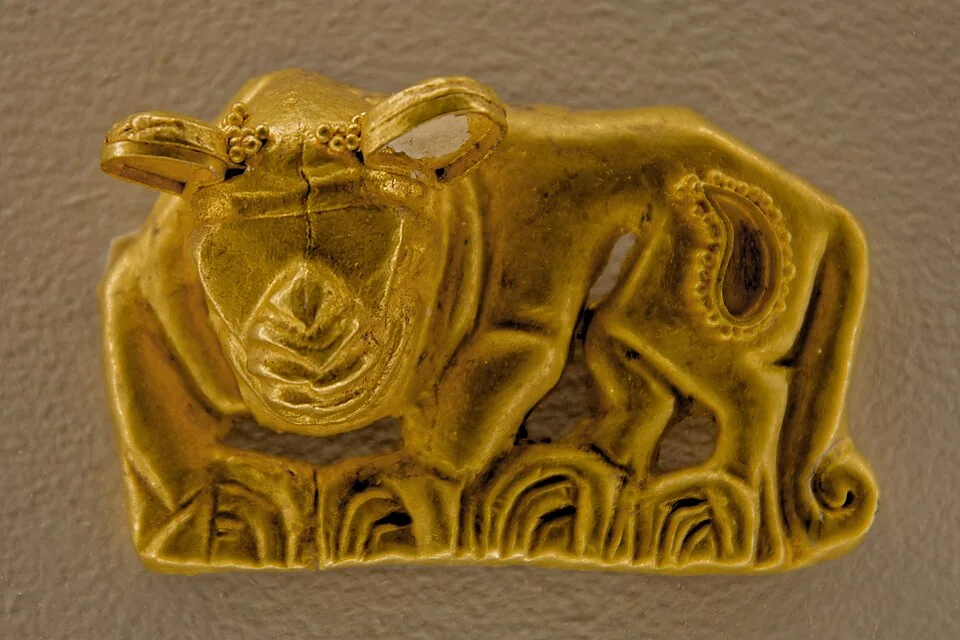
Animal imagery and precious materials connect Sarmatian art with wider steppe traditions. Powerful animals could express protection, status, or relationships with a nonhuman world. Identifying every image as the portrait of a named god is unwarranted.
Contacts with Black Sea cities, the Roman world, and other steppe peoples introduced objects and artistic forms into local settings. A Roman coin in a grave, for example, can acquire a funerary role different from its use as currency. Such exchanges show religious and material adaptation rather than a sealed, unchanging culture.
Relations with Other Iranian Traditions
Scythian religion and later Alan traditions provide useful comparisons. Their evidence should remain separate before historical connections are proposed. In particular, Herodotus's Scythian divine names cannot simply be relabelled as a documented Sarmatian pantheon.
The Ossetian Nart epics preserve important Iranian-language traditions in the Caucasus. Possible inherited motifs invite investigation, but the long interval and changes in language, society, and religion prevent treating the epics as an unchanged transcript of Sarmatian belief.