Haitian Vodou developed through the religious knowledge and creativity of enslaved Africans and their descendants, drawing on West and Central African traditions in interaction with Catholicism and life in Saint-Domingue and Haiti. It is also practised in diaspora communities. Serving the spirits involves inherited relationships, ritual work, healing, and obligations to people as well as to unseen beings.

Bondye and the Lwa
Bondye is God, while the lwa are powerful spirits involved in human affairs. Practitioners cultivate particular relationships with them through family inheritance, initiation, dreams, and religious consultation. Vodou has no single administrative authority defining every congregation's practice.
The lwa are organized through overlapping families and ritual nations. Rada and Petwo are important classifications, but they should not be translated into a simple opposition between good and evil. Temperament, history, ritual style, and the needs of a ceremony all matter.
Legba and Communication
Papa Legba is associated with access, thresholds, and communication. Opening a ceremony requires the possibility of addressing other powers, making his role relational rather than merely that of a doorkeeper.
His familiar presentation as an older man contrasts with popular entertainment's tendency to portray all Vodou spirits as threatening figures. Details of appearance and service vary by house and ritual context.
Danbala and Ayida Wèdo
Danbala is associated with serpents, purity, continuity, and primordial authority. Ayida Wèdo has rainbow and serpent associations and is frequently paired with him. Their presence is expressed through distinctive offerings and embodied conduct.
Danbala's significance is not exhausted by a creation-story label. In a congregation, a lwa's character becomes known through songs, remembered encounters, images, and ceremonial relationships. Haitian ritual flags dedicated to him, Ogou, and Ezili Dantò also connect spiritual identity with memories of the revolution. Fowler Museum, Saluting Vodou Spirits.
Ezili's Different Personalities
Ezili Freda is associated with beauty, love, luxury, and longing. Her refinement can coexist with grief: material abundance does not necessarily satisfy desire. Ezili Dantò is a forceful maternal and protective figure whose power includes anger and defence of those in her care.
These figures should not be collapsed into one goddess with a list of contradictory traits. Nor do they simply reproduce a binary between a gentle woman and an aggressive woman. Scholarship and practitioner interpretation examine their relationships with class, gender, diaspora experience, and different kinds of vulnerability. Harvard Divinity Bulletin, An Equilibrist Vodou Goddess.
Ogou, Agwe, and Zaka
Ogou figures concern iron, warfare, authority, and the demands of leadership. Different named manifestations have their own temperaments. His martial capacity can protect, but it can also expose the tensions of force and political power.
Agwe is associated with the sea and navigation, while Lasirèn connects aquatic imagery with beauty, wealth, and mystery. Zaka, often addressed through agricultural and familial language, concerns farming, work, and sustenance. These powers relate everyday livelihoods to the sacred world.
The Gede and the Dead
The Gede combine death with startling vitality, humour, sexuality, and protection. Their irreverent behaviour can challenge social pretension and bring attention to truths people avoid. The Baron figures and Grann Brijit have particular cemetery and death-related associations.
The dead are not simply interchangeable with the Gede. Family ancestors, named spirits, and ritual powers require their own relationships and forms of attention. Commemoration and service connect people across generations.
Ceremony and Spirit Possession
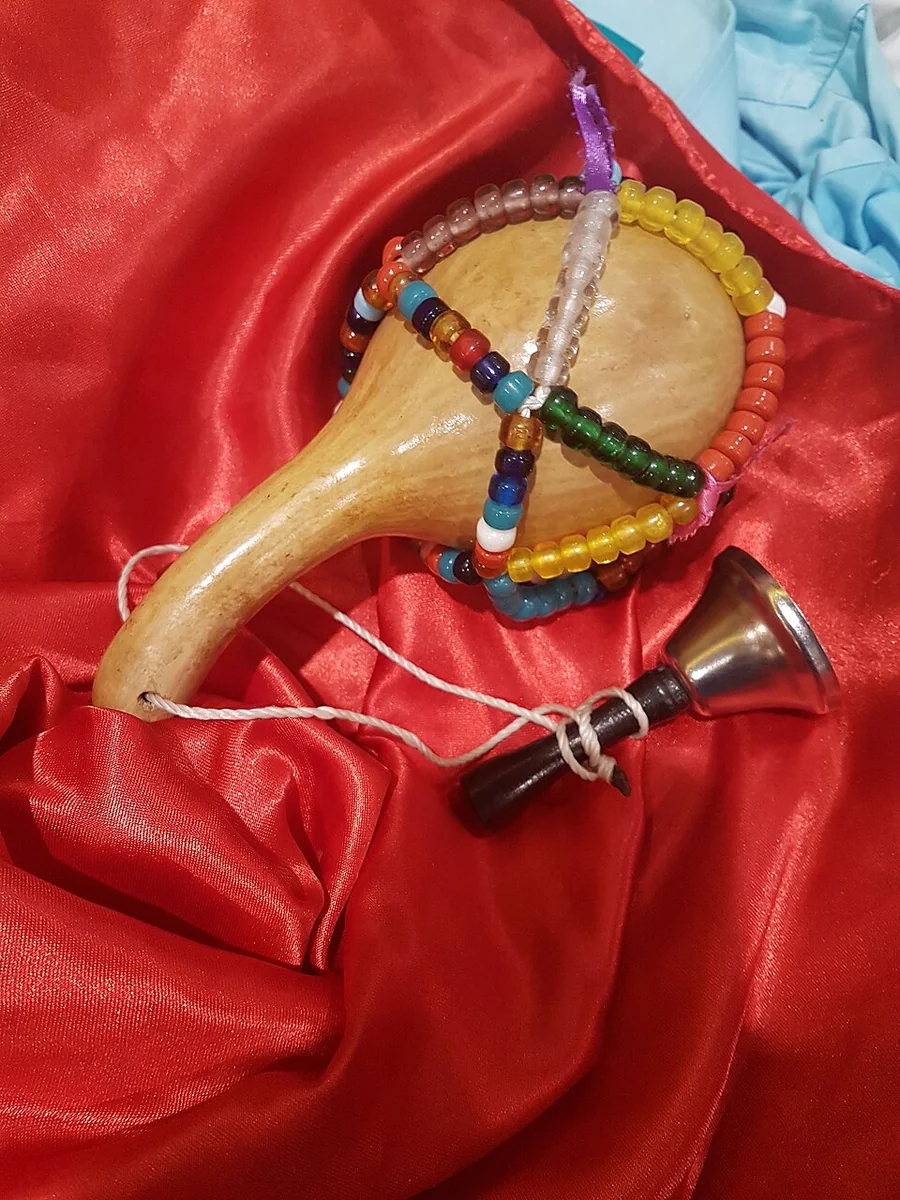
An oungan or manbo leads religious work in relation to a community and lineage. Songs, rhythms, dance, offerings, and sacred diagrams called vèvè help establish a setting for encounters with the lwa. Spirit possession is often described as a lwa mounting a person, whose speech and conduct are then understood as the spirit's manifestation. Harvard Pluralism Project, serving the spirits.
Music is not simply background accompaniment. Distinct rhythms and songs organize the ceremony and address particular spirits. Religious knowledge includes knowing when and how to perform them. Médiathèque Caraïbe, Vodou music in Haiti.
Catholic Images and Historical Memory
Saint images and feast days can participate in Vodou practice. Their significance exceeds a simple claim that African deities were hidden behind Catholic pictures: worshippers have developed sustained relationships with both visual and ritual traditions.
Vodou has also endured persecution and caricature. A Smithsonian ritual gong was confiscated during an anti-Vodou campaign in 1941, making the object's collection history part of the history of religious suppression. Smithsonian, ritual gong.
West African Vodun shares historical connections with Haitian Vodou but has distinct communities and institutions. Neither tradition is accurately represented by fictional accounts of indiscriminate curses or animated corpses.