Vodun traditions are practised among Fon, Ewe, and neighbouring peoples in parts of Benin, Togo, Ghana, and surrounding regions. The term refers to divine or spiritual powers and to religious traditions organized around relationships with them. Communities differ in language, histories, pantheons, and ritual institutions.
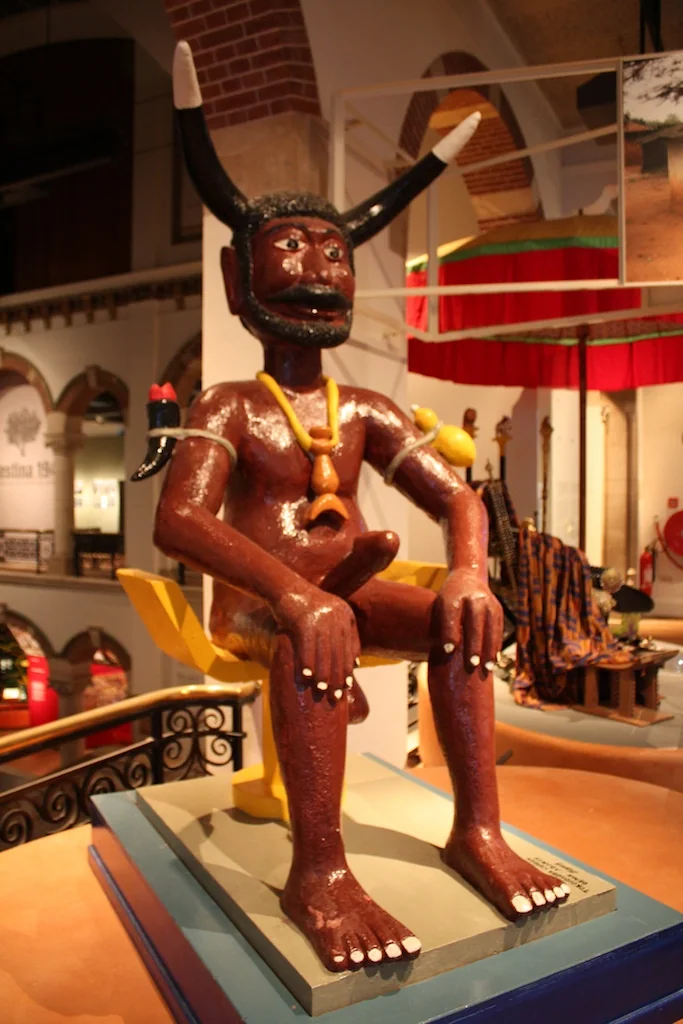

West African Vodun is historically connected with Haitian Vodou and other Atlantic religions, but their development under slavery, colonialism, and migration produced distinct traditions.
Mawu and Lisa
In influential Fon accounts, Mawu and Lisa form a complementary creative pair. Mawu is commonly associated with female and lunar qualities, Lisa with male and solar qualities. Other formulations combine or arrange these powers differently.
Creation concerns an ordered world sustained through relationships among divine beings, humans, and the environment. The creator pair should not be treated as an inflexible doctrine shared by every Ewe and Fon community.
Religious imagery can express these relationships indirectly. A Fon memorial altar in the Smithsonian collection includes a chameleon associated with Lisa and a cross interpreted in that context as a sign of Mawu. The cross need not carry only a Christian meaning. Smithsonian National Museum of African Art, Fon altar.
Legba: Mediation and Uncertainty
Legba is associated with communication, thresholds, and the unpredictable consequences of human action. He can facilitate relationships with other powers while exposing the limits of human assumptions. His trickster character is not equivalent to absolute evil.
Ritual objects can embody efforts to direct his capacities toward healing, protection, or a desired outcome. A hat associated with Legba devotees uses wrapped and bound amulets, showing how material construction participates in religious action. Smithsonian, hat with amulets.
Legba's prominence at boundaries and points of access makes him important to the organization of ritual space. Related figures elsewhere in the Atlantic world have developed their own attributes and should not be assumed identical.
Gu and Transformative Work
Gu is associated with iron, warfare, and the transformative capacities of tools. Iron enables cultivation and skilled production as well as violence. The deity's significance therefore extends beyond a narrow military role.
In the kingdom of Danhomè, royal religious objects connected Gu with the protection and power of the state. The Metropolitan Museum describes fortified sculptures placed in palace shrines during war as recipients of prayers and sacrifices to him. Metropolitan Museum of Art, Fon buffalo figure.
Thunder, Earth, and Serpent Powers
Hevioso, also written Hebioso, is associated with thunder and lightning. The dramatic force of storms can express divine authority and punishment. Sakpata concerns the earth and is especially associated with disease and healing, historically including smallpox. These relationships join danger with the capacity to restore wellbeing.
Dan-related serpent powers connect continuity, movement, and the maintenance of the world in different local accounts. Aido-Hwedo is prominent in some Fon narratives concerning a serpent's support of the earth. Such stories belong to particular collections and should not be presented as a universal West African creation creed.
Divine names can designate families of powers or localized manifestations rather than one individual with an identical biography everywhere. Initiation into a particular cult introduces a devotee to its own songs, obligations, and ritual knowledge.
Initiation, Music, and Embodiment
Religious institutions train initiates through periods of instruction and regulated participation. Songs, dances, dress, and ceremonial names establish relationships with the deity and the community responsible for its service.
A film made by Jean Rouch and Gilbert Rouget documents Sakpata initiates and the specific dances learned within their institution. The record concerns a particular historical setting, not every contemporary initiation. Musée du quai Branly, Sortie des novices Sakpata.
Possession can make a deity's presence visible through a devotee's body and conduct. Recognition depends on shared knowledge of the power being served; it is not merely an individual spectacle.
Ancestors, Divination, and Objects
Ancestors remain involved in the lives of descendants through memorial practices and inherited responsibilities. Asen memorial altars can evoke a person's identity through carefully chosen figures and scenes.
Divination, including Fa traditions, addresses circumstances requiring interpretation and action. It belongs to a wider regional history of linked divinatory systems, with local forms of training and authority.
Consecrated objects, including bocio, are produced through the work of artists and religious specialists. Their materials, attachments, and ritual histories matter. Describing them only as “fetishes” obscures the relationships and knowledge through which they act. Metropolitan Museum of Art, bocio with opposing faces.