Taíno is a conventional name for related Indigenous societies of the Greater Antilles and neighbouring islands at the time of European colonization. Their communities were not identical, and much written evidence comes from Hispaniola through the accounts of Europeans and Indigenous informants working under colonial conditions.

Ramón Pané's late fifteenth-century account is particularly important. Its translation history and the circumstances of collection require care, but it preserves named beings and narratives not recoverable from objects alone.
Cemís and Sacred Presence
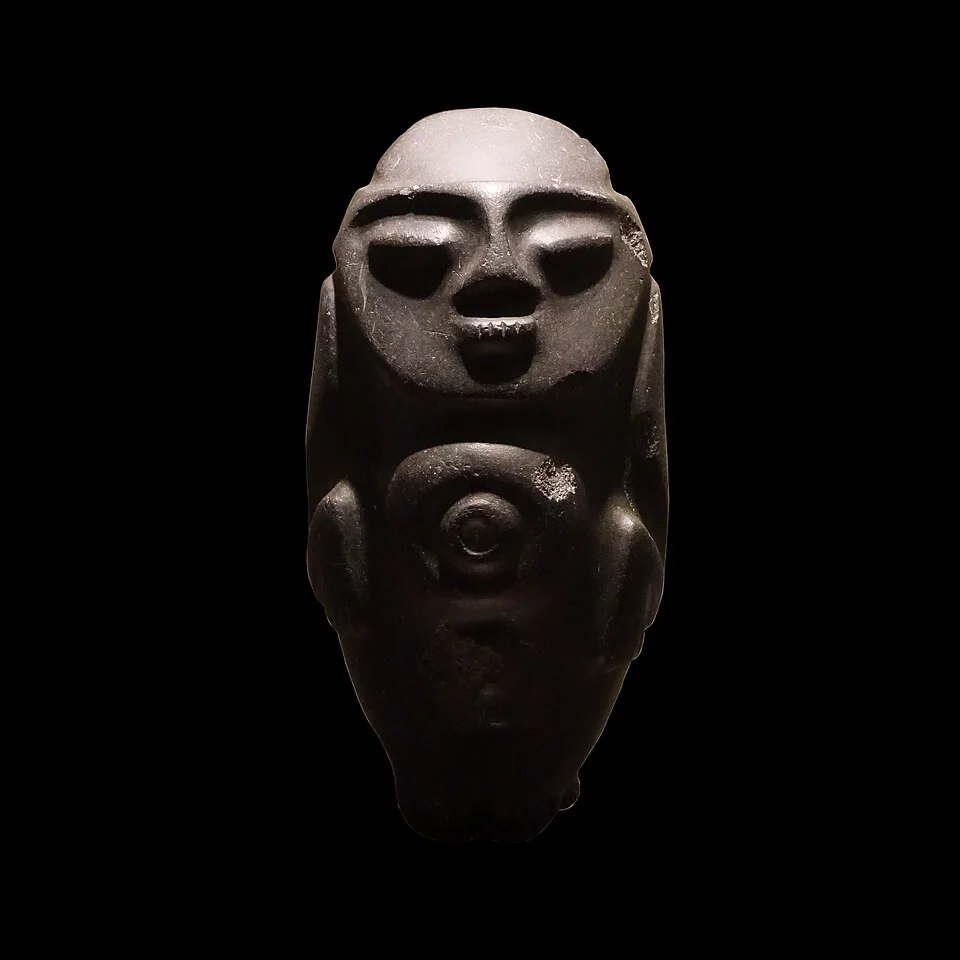
Cemí, also spelled zemí, can refer to a powerful being and to a material form through which its presence is engaged. Cemís may concern divine powers or ancestors. They were made from several materials, including stone, wood, and cotton, and could be associated with particular leaders and communities.
A carved object is therefore not simply an illustration of a myth. Its power depended on its history, owner, and ceremonial relationships. Different forms, including three-pointed stones and anthropomorphic figures, should not all be assigned one meaning without evidence. Museo Chileno de Arte Precolombino, Taíno sacred practice.
Yúcahu and Atabey
Yúcahu, recorded with a longer name in colonial sources, is associated with cassava, sustenance, and the conditions supporting life. Atabey, his mother, is connected with water and fertility. Her several recorded names or titles need not indicate a set of wholly separate goddesses.
Their relationship situates food production and reproduction within a sacred order. Descriptions such as “supreme creator” reflect both the surviving accounts and later interpretation; they should not force Taíno religion into a rigid theology resembling the recorder's own Christianity. Dominican Republic museums, cemís and ritual.
Guabancex and Storms
Guabancex is a formidable female power associated with destructive wind. Her story concerns the danger of storms to houses, vegetation, and human life. The same environment that provides food and water can become violently disruptive.
Named associated beings in Pané's account have roles involving the announcement and gathering of storm waters. These narratives give storms personalities and relationships; they are more specific than the generic statement that Taíno people “worshipped nature.”
Deminán Caracaracol and the Origins of the Sea
Deminán Caracaracol is one of four brothers whose actions transform the world. In the narrative involving Yaya and his son Yayael, the son's remains are placed in a gourd and become associated with fish. When the brothers disturb the gourd, its contents escape and the sea emerges.
The story joins death, food, curiosity, and a change in the scale of the world. The brothers do not simply create through a deliberate plan; consequential events arise from their actions and encounters. Pané's account preserves this sequence in a text whose versions and translations must be identified. Scholarly discussion and excerpts from Pané.
Another episode links Deminán with a swelling on his back from which a turtle emerges. Museum interpretations connect distinctive bodily features in some figures with this narrative, while acknowledging the work of identification involved. Smithsonian National Museum of African American History and Culture, Taíno figure; National Museum of the American Indian, Deminán cemí.
Caves, Ancestors, and the Dead
Pané records emergence traditions in which caves are ancestral places. Human origins are attached to a specific landscape, not only to an abstract beginning of time. Transformations explain other beings and features of the world.
The dead retain a presence in accounts of nighttime encounters and the realm associated with Maquetaurie Guayaba. Their relation to the living can involve both recognition and uncertainty. These stories should not be reconstructed as a uniform Caribbean afterlife doctrine shared by every island community.
Cohoba and Ceremonial Authority
Cohoba ceremonies involved a psychoactive powder and the consultation of cemís. Religious specialists, often called behiques in the sources, addressed illness and unseen conditions. Leaders also participated in religious action, connecting spiritual consultation with political authority.
Duhos, carved ceremonial seats, and specialized implements supported this work. Chant, movement, preparation, and the status of participants mattered alongside the substance itself. Public performance and remembered narratives also maintained histories and communal relationships.
Colonization and Continuing Identity
Enslavement, disease, warfare, and colonial reorganization caused catastrophic losses and disrupted the transmission of knowledge. They did not erase all Indigenous ancestry or cultural continuity. Contemporary Taíno identities and cultural work develop through descendants, communities, archaeology, and critical engagement with the surviving sources.
The Indigenous Caribbean overview places these traditions alongside other peoples of the region while retaining the differences between them.