Santería, also known as Regla de Ocha or the Lucumí tradition, developed in Cuba through the religious work of enslaved Africans and their descendants, particularly Yoruba-speaking people. Catholicism and other Cuban traditions affected its history, but it is not simply African worship hidden behind saints. It has its own lineages, initiations, ritual knowledge, and debates about correct practice. Smithsonian Folklife Festival, Santería.

Olodumare, Orishas, and Ashé
Olodumare is supreme divine power, while the orishas, or orichas in Spanish spelling, are the beings with whom much ritual life is directly concerned. Ashé refers to the power and efficacy through which life and sacred action are accomplished. It is transmitted and maintained through relationships, substances, speech, and properly conducted rites.
The orishas are not merely symbols of psychological traits. Their personalities emerge through stories, songs, divination, and the relationships of initiated people with them. A single association such as river, thunder, or iron identifies only part of an orisha's significance.
Major Orishas
Elegguá is associated with roads, openings, choice, and the possibility of communication. His unpredictability teaches attention to what appears small or easily overlooked. Ogún concerns iron, tools, and the force of work and conflict, while Ochosi is associated with hunting and exact aim. These figures have important relationships in ritual without becoming one interchangeable power.
Obatalá is associated with the formation of human beings, composure, and clarity. White clothing and coolness are prominent in many descriptions of his worship. Changó combines thunder, fire, kingship, dance, and passionate force. Narratives can portray both his attraction and the consequences of excess.
Yemayá is a powerful maternal figure associated in Cuba with the sea. Ochún concerns fresh waters, beauty, sweetness, and forms of persuasion that can accomplish what force cannot. Oyá is associated with winds, transformation, and the boundary of the dead. Different caminos, or paths, express distinct manifestations and histories; they are not always reducible to separate personalities in a universal list.
Orula, or Orunmila, is associated with divination and wisdom concerning destiny. His relationship with Ifá provides a distinct body of knowledge and specialist practice. The spelling and attributes of Yoruba-derived figures changed in Cuba, so a Nigerian account should not automatically substitute for a Lucumí one. Harvard Pluralism Project, Lucumí.
Stories and Divination
Narratives often called patakíes concern agreements, mistakes, generosity, rivalry, and the consequences of failing to respect an obligation. They are especially meaningful in relation to divination and a person's circumstances. A story about an orisha's flawed action need not command a devotee to repeat that action.
Different systems of divination are used by appropriately trained practitioners. They identify conditions, obligations, and possible responses rather than merely supplying a prediction detached from religious responsibility. Recommendations may include offerings, changes in conduct, or further ritual attention. Harvard Pluralism Project, Regla de Ocha-Ifá.
Initiation and Religious Kinship
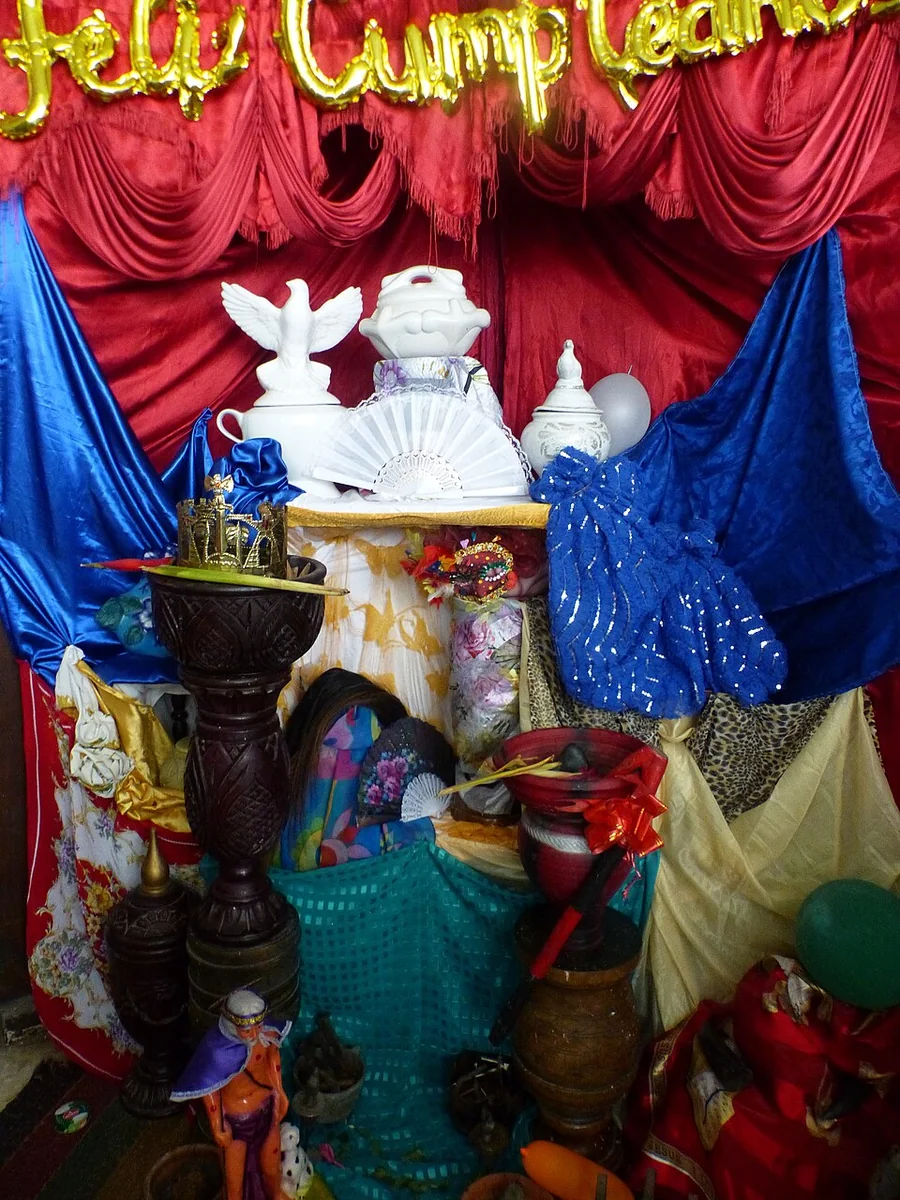
Initiation establishes enduring relationships with an orisha and a religious lineage. Godparents and elders carry responsibilities for teaching and care, while initiates assume obligations that continue long after the ceremony. The religious birthday commemorates initiation rather than replacing the person's ordinary birth date.
Training is progressive and much knowledge is restricted to those prepared to receive it. Public descriptions can explain the institution without presenting private ceremonial instructions as universally available information.
Drumming, Song, and Presence
Batá drums and sung invocations are central in important ceremonial settings. Rhythms and songs address particular orishas and follow knowledgeable sequences. Initiated drummers and other participants have responsibilities that distinguish sacred performance from a concert using similar musical forms.
Possession may be understood as an orisha's presence through a devotee. The event occurs within a ritual community that interprets and responds to it. It should not be described automatically as either theatrical pretence or medical pathology. Smithsonian Folkways, sacred rhythms and accompanying notes.
Offerings, Ancestors, and Other Traditions
Offerings can include food, drink, plants, and, in some rites, animal sacrifice. Their meaning depends on the recipient and the divined or ceremonial purpose. It is inaccurate to treat every offering as identical or to sensationalize one material aspect while ignoring prayer and care.
The dead have an important place, but ancestral observance, Espiritismo, Palo, and Ocha are distinct traditions even where practitioners participate in several. Catholic saint associations likewise vary by lineage and individual. Modern communities outside Cuba continue to negotiate these relationships while maintaining religious families across national borders.