Palo refers to a group of Cuban religious traditions with substantial Kongo and Central African roots. Names such as Palo Monte, Mayombe, Briyumba, and Kimbisa identify overlapping historical and ritual lineages rather than a single centrally governed church. Enslavement, colonial Cuba, Catholicism, and relationships with other African-derived religions shaped their development.
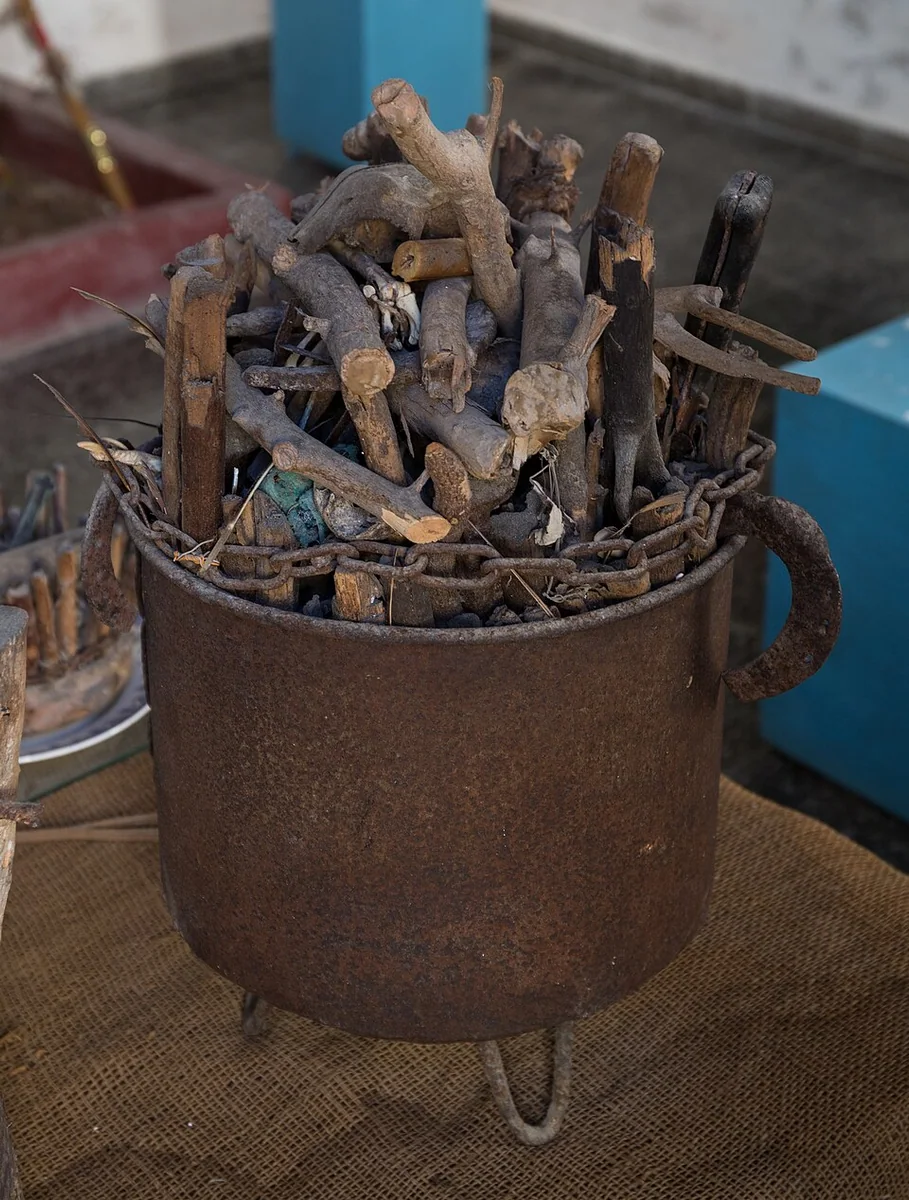

Palo is distinct from Santería, even though some people participate in both. Treating it as a darker or less respectable form of another religion repeats longstanding prejudice and obscures its own institutions and understandings of the dead.
The Dead and Their Presence
The dead are central to Palo. They are not only remembered ancestors residing at a distance; they can be active presences with whom practitioners cultivate demanding relationships. Divination, healing, protection, and responses to misfortune depend on those relationships.
Todd Ramón Ochoa's ethnographic work describes a Cuban-Kongo religious house through its particular practitioners and its dealings with the dead. His approach emphasizes lived relationships rather than reducing Palo to a list of objects or purported magical techniques. Columbia University, Ochoa's research.
Prenda, Nganga, and Nkisi
A prenda or nganga is a constituted centre of spiritual activity. It may take the form of a vessel containing materials with particular histories and powers. The vessel's significance depends on consecration, relationships, and continuing work; it is not simply a container whose ingredients mechanically generate an effect.
The word nganga has a different history in Kikongo, where it refers to a specialist or healer. Its Cuban usage illustrates how African languages and concepts changed within new social conditions. Nkisi and related forms also belong to this history of religious transformation.
Ethnographic research describes these material assemblages as active and demanding partners. They can protect and assist, but the relationship requires attention and obligations. A public description cannot convey the lineage-specific knowledge through which a house makes and maintains one. Ochoa, “Prendas-Ngangas-Enquisos”.
Divine and Spiritual Powers
Names derived from Nzambi or Nsambi refer to supreme divine power in many accounts. Practitioners also speak of mpungos and other spiritual entities. Their identities and relationships vary among houses; they should not be organized into a supposedly universal chart borrowed from Yoruba orisha worship.
Lucero, Zarabanda, Siete Rayos, Madre de Agua, and other names occur in documented practice. Associations with roads, iron, storm, or water may help an outsider recognize broad themes, but they do not exhaust the personalities or obligations known within a lineage. Identifying one of these powers with an orisha or Catholic saint is a historically situated comparison, not proof that the figures are identical. Etnolinguistic study of Palo's Kongo origins.
Religious Houses and Initiation
A religious house connects experienced leaders with initiated members through relationships often expressed in the language of kinship. Titles such as tata and yaya identify forms of authority and responsibility. Initiation creates obligations to the house, its elders, and its spiritual foundations.
Authority includes practical knowledge of plants, speech, divination, songs, and ritual histories. Different houses may disagree about correct practice. Such disagreements are part of religious life, not evidence that only one lineage possesses a recognizable tradition.
Healing, Protection, and Conflict
People approach Palo specialists for help with illness, vulnerability, family trouble, and other difficult circumstances. Work can involve cleansing, offerings, consultation with the dead, and attempts to restore an effective relationship between the person and their surroundings.
Power can also be implicated in conflict. Ethnographic accounts describe tensions between practitioners, elders and initiates, and the living and the dead. Acknowledging these tensions does not justify reducing the religion to harmful sorcery. The same relationships can be sources of care, obligation, protection, and fear. “Working the Dead in Cuban Palo,” Current Anthropology.
Language, Song, and Historical Memory
Palo ritual language preserves and reshapes Kongo-derived vocabulary alongside Cuban Spanish. Songs, invocations, and drawn signs communicate relationships with spiritual powers and with the histories of a house. Their meanings cannot reliably be recovered through a word-for-word dictionary alone.
The religion's history includes racialized policing and sensational representations of African-derived practice. Scholarship and practitioners' accounts require attention to that history when discussing ritual materials, secrecy, and the dead. An account grounded in a particular house is more informative than claims about what all paleros supposedly believe or do.