The Nyishi are one of the Tani-speaking peoples of Arunachal Pradesh and neighbouring areas of northeastern India. Their oral traditions describe relationships among human ancestors, celestial powers, spirits, animals, and the land. There are local variations in names, narratives, and ritual practice. Christianity and organized Indigenous religious movements are also part of contemporary Nyishi life.

Origins and Abotani
Abotani, or Abo Tani, is an ancestral figure shared across Tani traditions, but his adventures are not identical in every community. He is resourceful and vulnerable: mistakes, difficult marriages, competition, and negotiations with spirits explain the conditions of human existence.
The Central Nyokum Committee records a Nyishi account in which creation begins with an undifferentiated condition, followed by the separation of earth and sky. The sun makes a habitable world possible. In the subsequent narrative, Abotani's errors disturb relations with celestial relatives and spirits. Agreements over offerings allow human descendants to survive. This is one published account, not a standardized text binding every Nyishi storyteller. Central Nyokum Committee.
Donyi and the Celestial World
Donyi, the sun, has a major place in accounts of life and ancestry. Sun-related figures may be addressed through kinship, making the relationship between humanity and celestial power familial as well as cosmic. “Donyi-Polo,” referring to sun and moon, is also used for organized Indigenous religious traditions in Arunachal Pradesh.
Modern prayer institutions should be distinguished from the older, locally transmitted ritual settings from which they draw. Nyedar Namlo in Itanagar is a contemporary place of worship and community activity associated with Nyishi Indigenous faith. Its roles include prayer, language, teaching, and the preservation of knowledge. These institutions demonstrate religious development rather than a religion frozen in an ancient form. Arunachal Pradesh Department of Information and Public Relations.
Spirits and the Conditions of Survival
Spiritual powers are involved in the health of people, animals, and crops. Relations with them can be protective or dangerous. Describing them simply as “demons” imposes a moral classification that does not capture negotiation, obligation, and the circumstances of particular encounters.
An account published in The Arunachal Times names Myote Sarok and Byago Kyasang in a story explaining ritual offerings. They threaten Abotani's possession of domestic animals, and negotiation establishes an acceptable relationship. The explanation connects present-day offerings with an ancestral settlement of competing claims. Names and emphases differ from other versions, illustrating the importance of identifying the teller or source. “Birth of Nyokum”.
Nyokum Yullo
Nyokum Yullo is a communal observance concerned with prosperity, cultivation, and the avoidance of calamity. Its requests extend beyond a single harvest to the fertility and welfare of people and domestic animals. The ritual seeks favourable relationships among the community, spiritual powers, and the environment.
The festival has changed as village observances have become larger public gatherings. Song, dance, invitations, and collective organization can make it an expression of Nyishi identity as well as an occasion of worship. A study of change in Nyokum places it alongside other Nyishi festivals, including Longte Yullo and Boori Boot. They should not be treated as alternative names for one ceremony. Study of Nyokum and historical change.
Ritual Specialists and Oral Knowledge
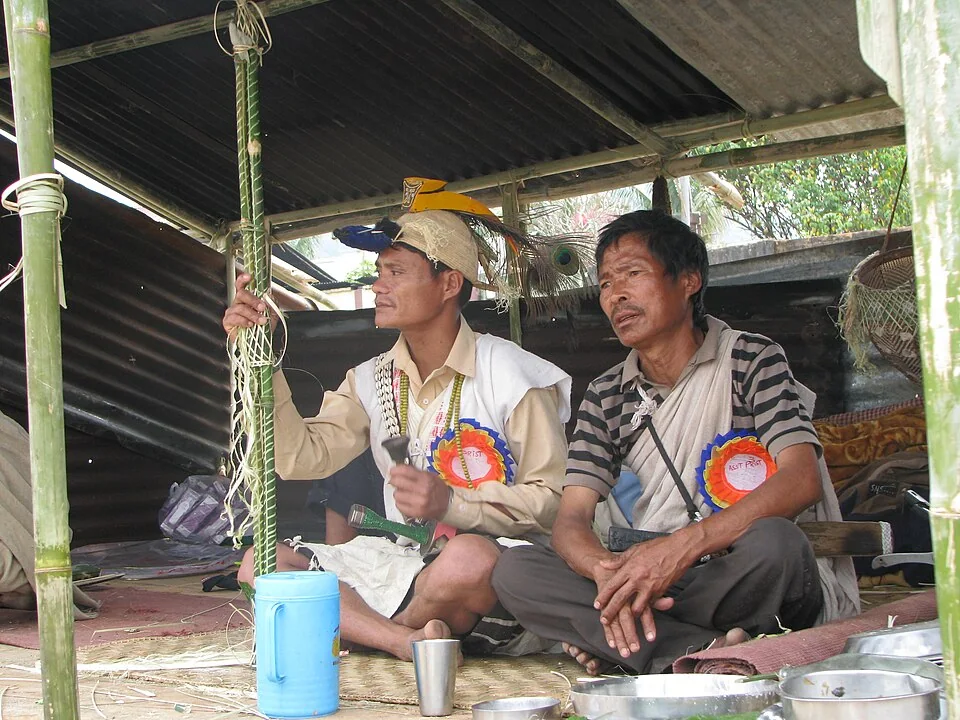
The nyubu, also spelled nyibus in some sources, is a ritual specialist whose knowledge includes recitation and the correct handling of relations with spirits. Ritual speech situates a present difficulty within remembered origins and obligations. Its effectiveness depends on trained knowledge, not merely on repeating a list of deity names.
Animal offerings are documented in a number of historical and continuing observances. Their meaning is explained through exchange and the protection of human life, rather than a generalized appetite for violence. Practices vary, and it would be inaccurate to assume that every Nyishi person participates or that every public festival follows the same procedures.
Oral transmission permits both continuity and variation. Spelling a name differently can reflect pronunciation or transcription rather than an entirely different being. Comparisons with Gond, Naga, or other regional traditions require specific evidence; geographical proximity alone does not establish a shared pantheon.