The Yezidis, also written Yazidis or Ezidis, are a religious community with historic centres in northern Iraq and communities in neighbouring countries and the diaspora. Their tradition has its own sacred narratives, social institutions, and forms of authority. It cannot be adequately classified as an incomplete version of Islam, Christianity, or an ancient Iranian religion.

Much religious knowledge has been transmitted orally in Kurmanji Kurdish. Accounts differ by region, performer, and context, and public summaries do not encompass every aspect of religious learning.
God and Tawûsî Melek
Yezidi belief recognizes a supreme God and a group of holy beings, with Tawûsî Melek, the Peacock Angel, occupying a central place. He is associated with the ordering and care of the world.
Outsiders have repeatedly misidentified him with the devil. That identification is a hostile distortion, not a description of Yezidi worship. Comparisons based on one motif, such as an angel's refusal to bow, must be interpreted within Yezidi accounts of divine command and loyalty rather than imported theological assumptions. Christine Allison, Encyclopaedia Iranica.
Peacock imagery gives material form to his presence, but he is not simply a bird god or an animal ancestor. His meaning belongs to a broader understanding of sacred manifestations and relationships.
Creation and the Pearl
Yezidi cosmogonic hymns describe an original state before the familiar world. A primordial pearl contains or precedes the unfolding of creation in several accounts. Its opening or dissolution is associated with the emergence of a differentiated cosmos.
Light, water, colour, and the establishment of the earth provide recurring images. The narratives are not all identical in sequence or emphasis. Reading them alongside their performance traditions is more informative than forcing them into a single modern timeline. Êzdîxan, creation and cosmogony.
Accounts of the formation of humanity likewise connect bodily existence with spiritual life and divine agency. The cosmic beginning is not simply a remote event: ritual and sacred language continue to recall its significance.
Sheikh Adi and Lalish
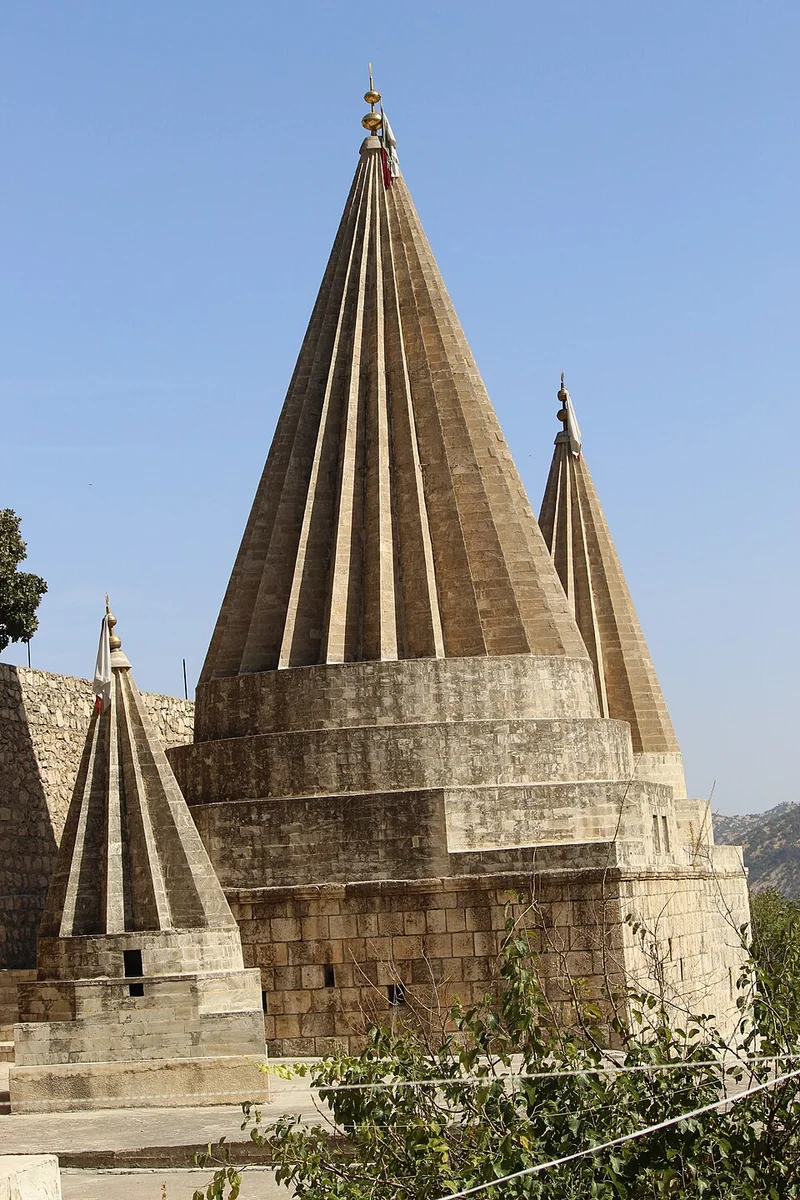
Sheikh Adi ibn Musafir is a historical religious figure whose presence in Yezidi sacred history exceeds ordinary biography. His tomb at Lalish is a focal point of pilgrimage and religious authority.
Lalish contains shrines, springs, and places associated with sacred narratives. Visitors participate through prescribed conduct and acts of reverence. The valley's significance is therefore experiential and ritual as well as architectural.
Saintly figures and their relationships with holy beings appear in hymns and stories. The distinction between historical person, sacred manifestation, and devotional title does not always map neatly onto an outsider's categories.
Qewls and Religious Knowledge
Qewls are sacred hymns transmitted through specialist knowledge and performance. They address creation, holy beings, ethics, and religious history. Their melodies and occasions of recitation form part of their meaning.
Qewwals perform with instruments including the def and şibab. Their work sustains relationships between religious learning, ceremonies, and communities. Ezidi Heritage, Qewls.
Modern scholarship has documented the movement from oral transmission toward written collections and questions of textual authority. Books marketed as the two definitive Yezidi scriptures cannot simply replace the much richer and better-attested oral corpus. Khanna Omarkhali, The Yezidi Religious Textual Tradition.
Festivals and Sacred Time
The spring New Year, commonly called Çarşema Sor or Red Wednesday, connects seasonal renewal with sacred history. Eggs, flowers, household observances, and visits to graves have roles that vary by community.
The autumn Feast of the Assembly at Lalish brings people together for a sequence of ceremonies and visits to sacred places. Collective participation connects pilgrims with religious specialists and with a landscape shared across dispersed communities.
Daily and seasonal acts of reverence can involve light, water, and the sun's direction. These practices should not be reduced to the claim that Yezidis worship the physical sun as their only god.
Community, Death, and Transmission
Hereditary religious relationships involving sheikhs, pirs, and lay families organize obligations and instruction. These institutions have specific histories and cannot be described solely through a generic model of clergy and congregation.
Some Yezidi teachings describe the soul's movement through successive lives, often expressed through imagery of changing garments. Accounts of death and sacred continuity coexist with responsibilities toward deceased relatives and their resting places.
Migration and persecution have dispersed families and threatened places of worship and transmission. Diaspora communities maintain ceremonies, publish hymns, teach younger generations, and debate how inherited knowledge should be shared in new settings.