Vietnam contains many ethnic and religious communities. This article focuses principally on Việt, or Kinh, traditions, while recognizing their regional variety and interaction with Buddhism, Confucian ethics, Daoist traditions, Christianity, and other religions. The beliefs of all peoples within Vietnam should not be absorbed into one national mythology.

Lạc Long Quân and Âu Cơ
A celebrated origin narrative joins Lạc Long Quân, associated with dragons and the watery world, with Âu Cơ, associated with a mountain or immortal lineage. She produces a hundred eggs from which their children emerge. Their eventual division between uplands and the coast explains both diversity and common ancestry.
Versions differ in the details of the separation and succession. The story's significance lies in the relationship between ancestral kinship, territory, and the Hùng kings, rather than in a literal account of population history. Vietnam's State Committee for Overseas Vietnamese, ancestral legends.
Sơn Tinh and Thủy Tinh
Sơn Tinh, the mountain power associated with Tản Viên, competes with Thủy Tinh, the water power, for a royal bride. When Sơn Tinh wins, Thủy Tinh raises the waters in anger. Sơn Tinh raises the land to resist him.
The recurring struggle gives seasonal flooding a personal and memorable form. The mountain god is protective, while the water rival embodies a threat that returns despite defeat. Their contest also connects marriage, royal choice, and environmental danger.
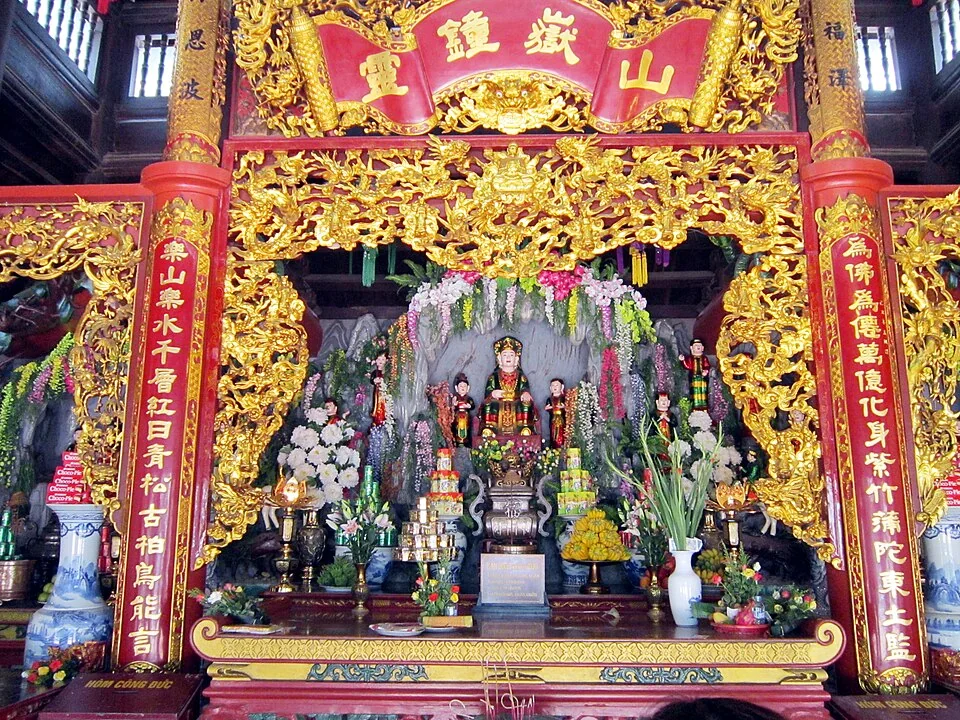
Sơn Tinh is counted among the Four Immortals, together with Thánh Gióng, Chử Đồng Tử, and Liễu Hạnh. This group gathers figures with different narrative histories rather than four interchangeable gods.
Thánh Gióng
Thánh Gióng begins as an extraordinary child who does not behave like other children. When the country is threatened, he grows into a formidable defender and rides into battle on an iron horse. His departure after victory moves him beyond ordinary human life.
Festivals at Phù Đổng and Sóc temples commemorate his achievements through elaborate ceremonial performance. Their concern extends from remembered defence to peace, harvests, and family prosperity. UNESCO, Gióng festivals.
The hero's transformation links apparently unpromising beginnings with the sudden emergence of protective power. Festival roles and ritual preparation make this story a communal activity rather than merely a tale about a distant warrior.
Chử Đồng Tử and Liễu Hạnh
Chử Đồng Tử is remembered through a story of poverty, an unexpected encounter with a princess, marriage across social boundaries, and access to extraordinary religious capacities. Different retellings emphasize love, trade, spiritual instruction, or miraculous transformation.
Liễu Hạnh is a heavenly figure whose earthly lives and encounters reveal both generosity and formidable independence. Her stories connect her with particular shrines and with the Mother Goddess tradition. She is not simply a passive maternal symbol: her authority can challenge those who misunderstand or disrespect her.
Mother Goddesses and Spirit Mediumship
Mother Goddess traditions organize divine relationships through realms such as heaven, water, and mountains and forests. Four-Palace formulations also include earth. The precise arrangement depends on the ritual tradition.
In lên đồng ceremonies, mediums embody a succession of sacred figures with distinctive clothing, gestures, music, and offerings. The assembly can include female and male figures with remembered histories and particular responsibilities. Devotees seek health, prosperity, guidance, and a renewed relationship with the sacred community. UNESCO, Mother Goddesses of Three Realms.
Sung chầu văn accompaniment helps identify and praise the figures appearing in ritual. Initiation, knowledge, and relationships with other practitioners matter alongside the visible splendour of a ceremony.
Ancestors and Village Guardians
Household altars and death anniversaries maintain relationships with deceased family members. Food, incense, and remembered names situate the living within a continuing lineage. Ancestor rites need not imply that every ancestor has become a universal deity.
Village communal houses honour tutelary figures whose identities may include local founders, protective powers, or deified historical persons. Imperial recognition, local legend, and community experience can all contribute to a guardian's authority.
Trần Hưng Đạo, the military leader, receives religious veneration in traditions that emphasize protection and the expulsion of harmful forces. Such devotion demonstrates how historical memory can become a source of sacred agency.
Buddhist and Household Observances
Buddhist temples honour buddhas and bodhisattvas, including Quan Âm, associated with compassion. Their teachings and institutions coexist with household and village practices without making every local god a Buddhist figure.
The Kitchen Gods' annual departure to report household affairs links domestic conduct with a wider celestial order. Lunar New Year observances bring together ancestors, renewal, offerings, visiting, and hopes for the coming year. Particular customs vary across regions and families.