Urartu was an Iron Age kingdom centred around Lake Van, with territories extending into parts of present-day eastern Turkey, Armenia, and Iran. Its inscriptions and archaeological remains document an organized royal religion. They preserve divine names, offerings, and assertions of divine support more fully than stories about the gods' personal adventures.
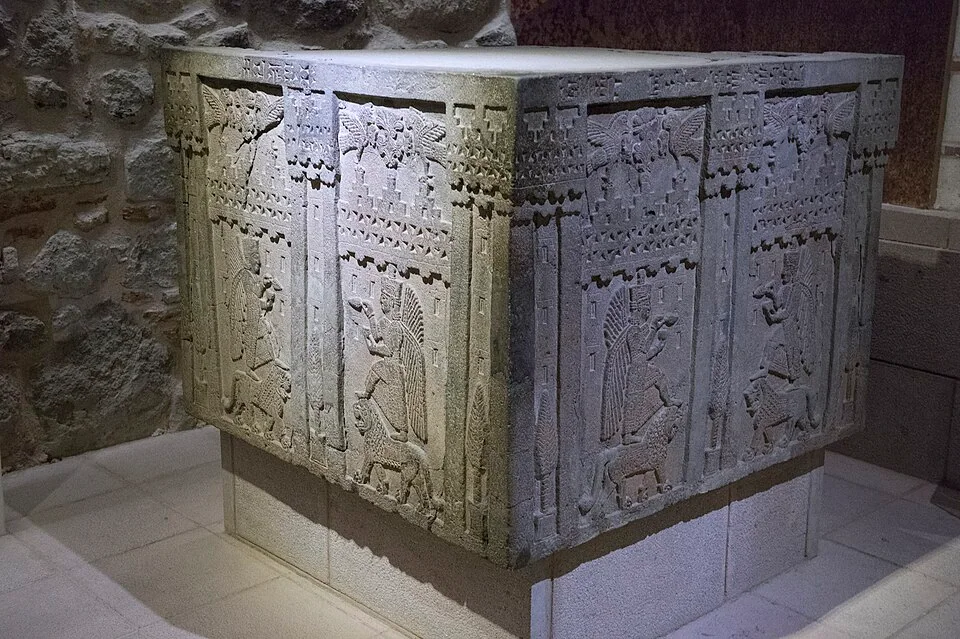

Urartian religion interacted with neighbouring traditions, particularly those of the wider ancient Near East. Similar artistic forms do not make its deities interchangeable with Assyrian or later Armenian figures.
Haldi and Royal Power
Haldi, also written Khaldi, was the leading deity of the Urartian royal pantheon. Kings credited him with supporting campaigns and victories. Temples, dedications, and ceremonial objects connected the god's power with the expansion and maintenance of the kingdom.
This relationship helps explain why surviving inscriptions emphasize warfare and royal accomplishment. It does not mean that warfare was the only concern of worshippers or that Haldi's significance can be exhausted by the label “war god.” The archaeological and inscriptional record is strongly shaped by elite patronage. Metropolitan Museum of Art, Urartu.
Musasir was an especially important centre of Haldi's worship. Its temple appears in Assyrian accounts of conflict with Urartu, giving evidence from a hostile neighbouring power as well as from Urartian sources.
Teisheba and Shivini
Teisheba was associated with storms and occupies a prominent position alongside Haldi and the solar deity Shivini, also transcribed as Shiwini or Šiuini. The order and scale of offerings in inscriptions help establish their relative standing in state ceremonies.
Teisheba's name is related to that of the Hurrian storm god Teshub. Such connections reveal historical relationships across the region, while local cults retain distinctive political and geographical settings. The fortress-city Teishebaini bore his name. Armenian Museum of Moscow, Teisheba.
Shivini's solar associations place him within a wider Near Eastern religious environment in which the sun could signify divine presence and cosmic regularity. The surviving evidence does not justify supplying a detailed Urartian solar epic from the stories of neighbouring peoples.
Goddesses and the Wider Pantheon
Arubani is identified as a major goddess and the consort of Haldi. Other goddesses and gods appear in lists that demonstrate a pantheon much larger than its three most frequently mentioned male figures.
Names preserved in inscriptions do not always come with clear functions. When a deity's identity rests on a short listing, an honest account must leave gaps rather than assign an attractive but unsupported personality. Museum scholarship on Urartian objects discusses Arubani and the difficulty of identifying individual figures. Metropolitan Museum of Art, Assyria to Iberia.
Offerings and Sacred Gates
The inscription at Meher Kapısı near Van lists offerings to numerous divine recipients. The quantities assigned to Haldi, Teisheba, and Shivini differ, making ritual hierarchy materially visible.
The list also addresses aspects of Haldi's power, including his weapons and qualities. This shows that divine agency could be approached through attributes as well as through a deity's name. The carved rock setting gives the inscription a relationship with place and a monumental threshold. Urartian cultural heritage project, gods and offering inscription.
Offerings of animals and objects connected religious institutions with the kingdom's resources. Temples were therefore part of political and economic life as well as places of encounter with divine powers.
Divine Images and Composite Beings
Urartian bronzes portray deities, animals, winged figures, and composite creatures. These images appear on furnishings, belts, vessels, and other objects. Their arrangement can express protection and royal authority without illustrating a recoverable narrative.
A surviving throne element shows a deity standing on a bull. Its position within a larger piece of furniture would have placed divine support beneath the ruler in a literal visual arrangement. The museum's identification remains appropriately broader than a certain assignment to a named god. Metropolitan Museum of Art, throne element with deity on a bull.
Burial and the Limits of Reconstruction
Burials contain evidence of social distinctions and practices surrounding death. Objects placed with the deceased show that funerary activity mattered, but they do not by themselves explain the destination of a soul or the organization of an underworld.
No surviving Urartian corpus supplies a comprehensive creation story or a narrative cycle comparable to Mesopotamian epics. Accounts of Urartian belief must therefore distinguish what inscriptions state, what objects depict, and what comparison with other cultures merely suggests.