The Toda are an Indigenous people of the Nilgiri Hills in southern India. Their religious traditions place sacred buffalo herds, dairy institutions, and particular places at the centre of community life. Toda people also participate in other religious traditions, including Christianity, and practices have changed with land use, livelihoods, and relations with neighbouring societies.
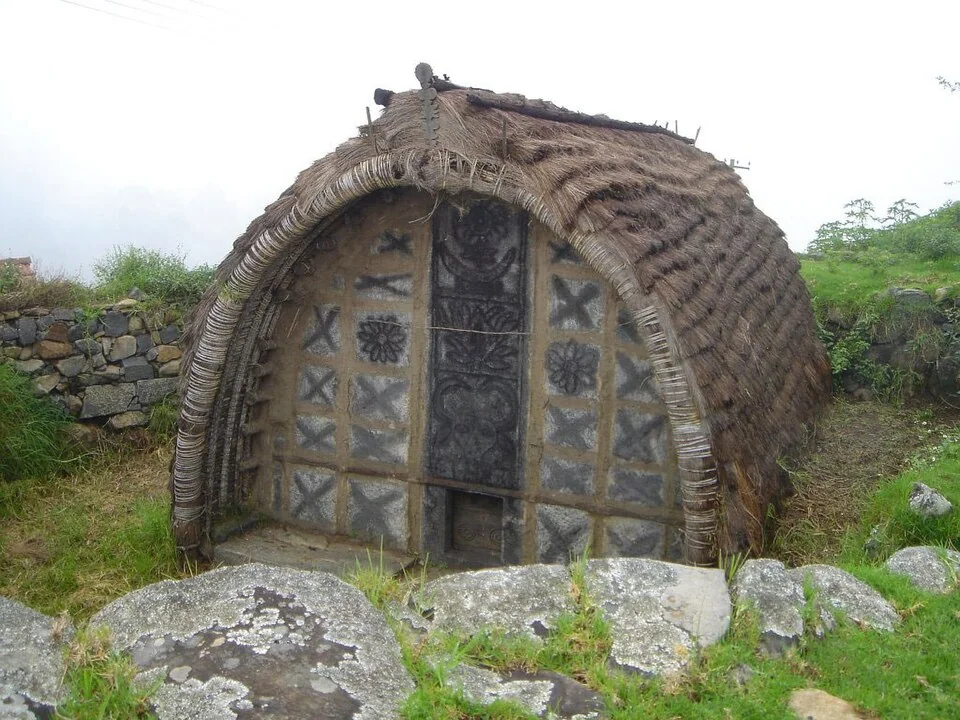

Gods and the Ordering of Life
Teikirzi, whose name has several spellings in ethnographic transcription, is a major goddess associated with the establishment of social and ritual arrangements. Accounts connect her with the allocation of buffaloes and the ordering of responsibilities among Toda groups.
On is associated with the realm of the dead. Sources differ in details of the relationship between major deities, and their spellings reflect attempts to represent Toda sounds in other languages. The names should therefore not be multiplied into separate gods merely because two authors transcribe them differently. Scheme for Protection and Preservation of Endangered Languages, Toda documentation.
Other divine figures are attached to particular places and groups. Myth identifies mountains, streams, and settlements as sites of actions that explain present obligations. Sacred geography makes the landscape a record of relationships and remembered events.
Buffaloes and Grades of Sanctity
Buffaloes are central to subsistence and ceremonial life, but not all herds have the same religious standing. Ethnographic accounts describe grades of sacred herds and corresponding dairy institutions. The distinctions affect who may handle the animals, process their milk, and enter particular spaces.
A sacred buffalo is therefore not simply an animal selected for an occasional offering. Its care belongs to an organized religious system. Routes, water sources, pastures, dairy vessels, and the people responsible for them can all have prescribed relationships.
W. H. R. Rivers's early twentieth-century study records extensive details, while also advancing outdated evolutionary interpretations of religion. Its descriptions must be separated from the author's assumptions about cultural development. Rivers, The Todas; Yale eHRAF, assessment of the source.
The Dairy as a Religious Institution
Sacred dairies are places of ritual work. Milking, processing, and handling vessels can involve prescribed actions and words. The dairyman's office combines practical labour with religious responsibility; calling him merely a farmer or merely a priest misses that conjunction.
Different offices carry different restrictions. Preparation for service, conduct while holding office, and permissible contact with other people help define the institution's sanctity. These regulations are not identical for every dairy grade or historical period.
Milk has a status linked to the herd, the officiant, and the context in which it is handled. The dairy system is consequently more specific than a generalized belief that all dairy products are divine. Scholarship on Toda religion also documents dimensions extending beyond the dairy cult. Anthony R. Walker, The Diverse Faces of Toda Religion.
Prayer and the Named Landscape
Ritual language refers to gods, sacred places, herds, and institutions through distinctive names and formulas. These forms preserve knowledge that is not always transparent in everyday speech or in translation.
Mountains and plants are implicated in ceremonies and accounts of divine action. Their significance depends on particular histories and uses. The requirement to obtain appropriate plant materials can make ecological knowledge integral to carrying out religious obligations. A discussion by Toda researcher Tarun Chhabra describes these relationships between ritual and the Nilgiri environment. Vikalp Sangam, Todas and the natural world.
Death, Buffaloes, and Community Obligations
Funerary traditions connect the deceased with kin, buffaloes, and the journey beyond human life. Older accounts describe complex sequences of ceremonies, including practices involving buffalo sacrifice. Historical descriptions should not be presented as a schedule followed unchanged by every contemporary family.
Lament, commemoration, and the participation of relatives give funerals a social as well as cosmological importance. Traditions concerning the dead also link an individual's destination with obligations performed during life.
Change and Religious Continuity
The reduction or reorganization of particular sacred dairy institutions does not mean that Toda religious identity has simply disappeared. People maintain, revive, debate, and adapt ceremonies under altered conditions. Written ethnography captures particular moments; community knowledge continues beyond those records.
Relations with neighbouring peoples and Hindu deities have also formed part of Toda experience. Recognizing these exchanges helps avoid portraying the Toda as an isolated survival from an unchanging past.