Tibetan religious life includes several Buddhist traditions, Bon, local ritual practices, and other religious communities. Tibetan Buddhism developed through translations and lineages linking the plateau with India and surrounding regions. Bon has its own literature, teachers, institutions, and accounts of religious history; it should not be treated simply as a collection of practices left over from before Buddhism.

Awakening and Divine Forms
Buddhist teachings describe suffering and repeated rebirth as conditioned by ignorance and harmful patterns of action. Buddhas and bodhisattvas provide models and means of awakening. Their images are not all gods in the sense of immortal creators.
Avalokiteshvara, called Chenrezig in Tibetan, embodies compassion. Manjushri embodies wisdom, and Vajrapani the power associated with awakened activity. Tara, or Drolma, appears in multiple forms and is approached for protection and liberation. The personalities expressed by these figures are inseparable from qualities practitioners seek to cultivate.
In tantric practice, a yidam is a meditational deity through whose form and ritual a practitioner engages a particular path. Such practice depends on instruction and, in many cases, initiation. A wrathful appearance does not by itself identify a figure as a protector; meditational deities and protectors are distinct categories that can overlap in particular traditions. Himalayan Art Resources, common confusions about protectors.
Padmasambhava and the Conversion of the Landscape
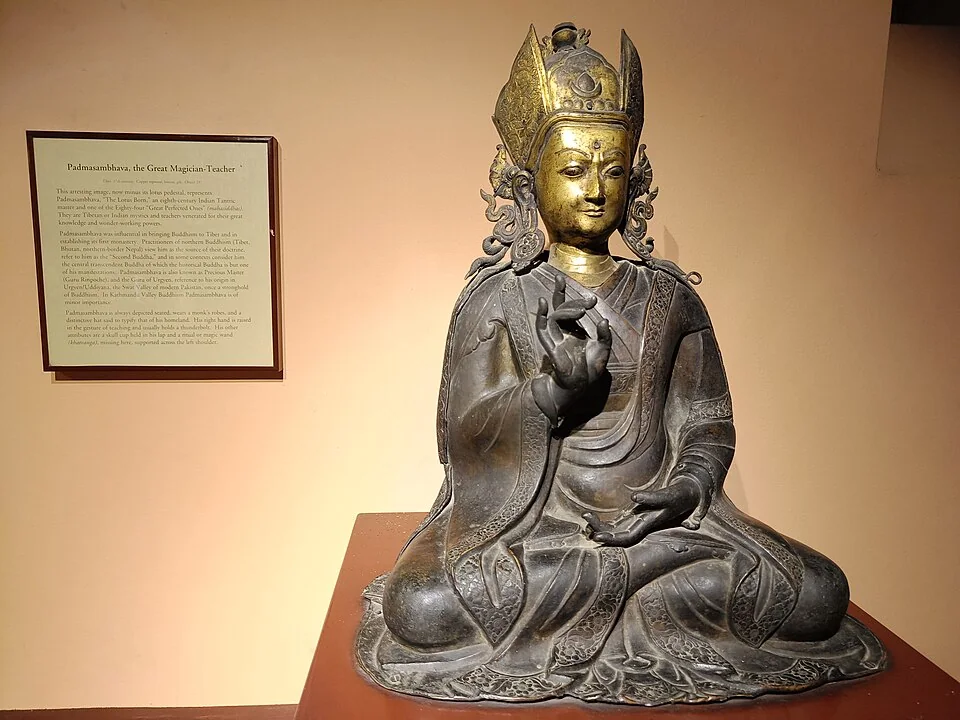
Padmasambhava, commonly called Guru Rinpoche, is central to accounts of Buddhism's establishment in Tibet and especially to the Nyingma tradition. His sacred biographies describe miraculous birth, mastery of tantric teachings, and encounters with obstructing forces.
Stories of his subjugation of spirits explain how powerful local beings became bound by oath to protect Buddhist teachings. Religious change is thus narrated through negotiated and enforced relationships with an already inhabited sacred landscape.
His eight manifestations present different aspects of his activity rather than eight unrelated gods. Stories about hidden treasures, or terma, explain how teachings associated with him become available to later generations through their revealers. Sacred biography and historical reconstruction address different kinds of questions about his life. Rubin Museum, Padmasambhava and his manifestations.
Protectors and Oracles
Mahakala appears in several forms associated with different lineages and functions. The White Six-Armed Mahakala, for example, has a particular relationship with the Shangpa Kagyu tradition and the provision of prosperity supporting religious activity. Himalayan Art Resources, White Mahakala.
Palden Lhamo is a formidable female protector, while Pehar and other worldly protectors have their own histories and ritual settings. Traditions distinguish enlightened protectors from worldly beings who remain within conditioned existence. This distinction matters more than a simple division between frightening and attractive images.
Oracular institutions involve trained religious settings in which a medium is understood to communicate a protector's counsel. They do not represent every form of Tibetan divination. Regional monasteries can maintain different protector relationships. Himalayan Art Resources, Gelug protectors.
Bon and Its Sacred History
Bon tradition identifies Tonpa Shenrab as its foundational teacher and connects him with sacred places beyond ordinary historical geography. Its teachings include ethics, ritual, cosmology, monastic learning, and contemplative disciplines.
Bon and Buddhist communities have influenced one another over centuries. Shared visual forms or practices do not erase their distinct accounts of authority. Nor should every local mountain rite be assigned exclusively to one tradition without evidence.
Mountains, Water Beings, and Offerings
Mountains can be the seats of protective powers whose relationships concern territory, prosperity, and community identity. Water-associated beings called lu, corresponding in some contexts to nagas, may be connected with illness when their habitats or relationships are disturbed.
Smoke offerings, cairns, prayer flags, and pilgrimage express relationships with such places. The meaning of a rite depends on its text, officiant, and community. A mountain may be approached through Buddhist, Bon, and local understandings that coexist without becoming interchangeable.
Gesar and Narrative Performance
The epic of King Gesar recounts a hero's struggles against enemies and disruptive powers. Its many regional versions combine warfare, magical capacities, political ideals, and religious interpretation. Oral performers preserve and reshape episodes rather than reciting one universally fixed text.
Gesar's horse and extraordinary allies participate in a world where human conflict extends into relations with nonhuman beings. The epic's religious associations vary, so it should not be read as a catechism shared by all Tibetans.
Death and Ritual Care
Funerary practices address the deceased, surviving relatives, merit, and the transitions associated with rebirth. Teachings about intermediate states, or bardo, provide one influential framework. Texts popularly grouped in English as the Tibetan Book of the Dead belong to particular textual traditions, rather than serving as the sole authority for every Tibetan funeral.