Ancient Thracian peoples inhabited parts of southeastern Europe, including much of present-day Bulgaria and neighbouring territories. They formed numerous communities and kingdoms rather than a single religious state. Greek and Roman writings, inscriptions, sanctuaries, and tombs supply different kinds of evidence, often from widely separated periods.
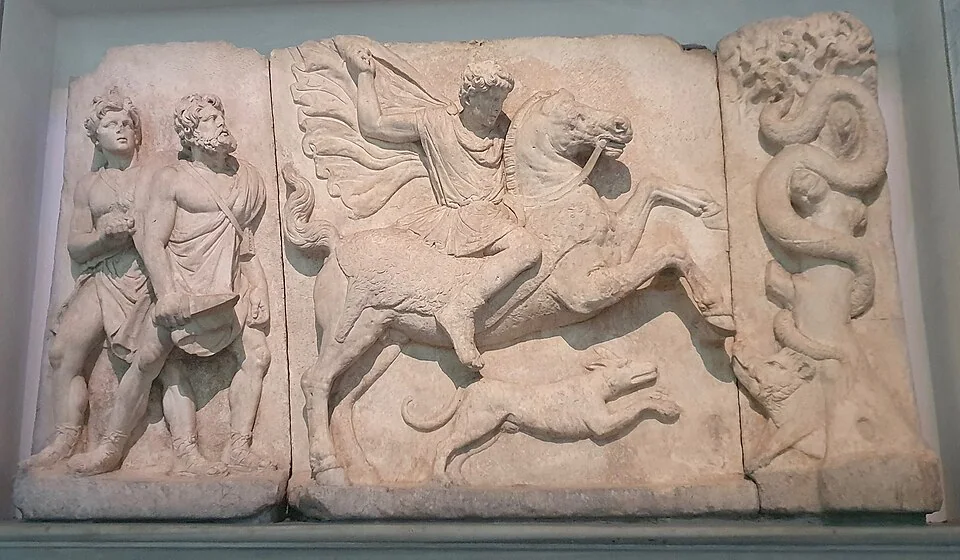

The surviving record does not preserve a Thracian equivalent of a complete mythological epic. Names and images can identify cults without revealing every story their worshippers told.
Bendis
Bendis is a Thracian goddess whose worship also became established at Athens. Greek observers compared her with Artemis, and images show a goddess equipped for movement and hunting. A votive relief in the British Museum presents her receiving worshippers, preserving evidence of an organized cult rather than merely a literary reference. British Museum, relief dedicated to Bendis.
Her identification with Artemis made her intelligible within Greek religious language, but it does not prove that every aspect of the two goddesses was identical. Inscriptions from a sanctuary on Samothrace also preserve her name and its association with Artemis. Archaeological Museum of Samothrace, Hall E.
The festival of Bendis at the Piraeus appears in the opening of Plato's Republic, including reference to a torch race on horseback. This is valuable evidence for her Athenian reception; it cannot automatically describe the goddess's rites throughout Thrace.
The Thracian Horseman
A mounted figure, conventionally called the Thracian Horseman or Thracian Rider, appears on many votive reliefs, particularly in the Roman period. He may approach an altar or a tree with a serpent, hunt an animal, or appear with other figures.
The rider's repeated form suggests a powerful and recognizable religious image. Individual dedications, however, connect it with different names and functions. It is safer to discuss a family of related heroic and divine representations than to assign every relief to one god with a single surviving biography.
The image concerns the meeting of human petitioners with protective power. Its use on votive monuments distinguishes it from a simple portrait of an elite cavalryman, even when heroic and aristocratic imagery overlap.
Zalmoxis and the Getae
Herodotus describes the Getae, whom he places among Thracian peoples, as holding distinctive beliefs about death and a being called Zalmoxis or Salmoxis. His account says they expected to go to Zalmoxis rather than simply cease to exist.
He also reports a Greek story in which Zalmoxis had been associated with Pythagoras, taught followers about continued life, and withdrew into an underground chamber before reappearing. Herodotus expresses uncertainty about aspects of the story. The text preserves competing explanations, not an unmediated statement of Getic doctrine. Herodotus, Histories, book 4, sections 94–96.
The same passage reports the dispatch of a human messenger to the deity through a lethal ritual. Its status as an outsider account matters: it should be attributed to Herodotus, neither silently accepted as universally representative nor omitted from discussion of the source.
Sabazios and Religious Exchange
Sabazios was worshipped across a broad area and became associated with divine figures recognizable to Greek and Roman audiences. His origins and connections are debated, and references to him should not turn every Phrygian or Anatolian practice into Thracian religion.
Roman-period objects include elaborate hands bearing symbolic figures. They demonstrate the cult's mobility and rich imagery, although the meaning of every symbol remains uncertain. The Vatican Museums describe Sabazios as possibly originating in Asia Minor and document his reception in Greece and Rome. Vatican Museums, bust of Sabazios.
Orpheus, Burial, and Sacred Authority
Greek narratives place the singer Orpheus in Thrace and make his music capable of moving animals, people, and powers of the underworld. His descent to recover Eurydice and his violent death became major themes in Greek literature and art. These stories demonstrate the religious significance Greeks assigned to Thrace; they are not a complete record of indigenous Thracian teaching.
Rich tombs and funerary imagery show that some elites invested heavily in the transition after death. Banquets, horses, weapons, and precious vessels connect burial with social rank and remembered identity. Archaeological display alone cannot establish a detailed doctrine of resurrection or prove that an image illustrates a particular lost myth.