Tamil religious life encompasses Hindu, Muslim, Christian, Jain, and other communities in southern India, Sri Lanka, and the diaspora. The mythology discussed here mainly concerns Tamil Hindu traditions. Their literature, temple institutions, and local practices developed through interaction with other South Asian traditions, rather than as an isolated religion.

Sacred Landscapes and Murugan
Early Tamil poetry associates different landscapes with distinctive human activities and divine presences. Murugan is particularly connected with the hills, youth, warfare, and love. Later traditions identify him with Skanda or Karttikeya, the son of Shiva and Parvati, while retaining a strong Tamil literary and geographical identity.
Murugan's spear, the vel, embodies his power to overcome destructive forces. His six celebrated abodes, the Arupadai Veedu, connect pilgrimage with episodes in his sacred biography. Devotees approach him as warrior, teacher, child, and compassionate protector.
In the Tamil Kanda Puranam tradition, Murugan defeats Surapadman, an adversary whose power threatens the gods. Surapadman assumes a tree form; Murugan divides it with his spear. The resulting peacock and rooster become the god's mount and banner emblem. The defeated enemy thus enters the victor's sacred identity. Murugan's marriages to Devasena, also called Teyvayanai, and Valli connect him with different social and mythological settings. Valli's courtship stories give the god a playful, persistent personality alongside his martial role. Murugan Bhakti, illustrated Kanda Puranam.
Shiva and the Dance at Chidambaram
Shiva combines asceticism, household life, destruction, grace, and creative power. Tamil Shaiva traditions emphasize particular temples and encounters through which devotees experience him. His consort appears under local names, including Meenakshi at Madurai, where her royal identity and marriage are central to the city's sacred history.
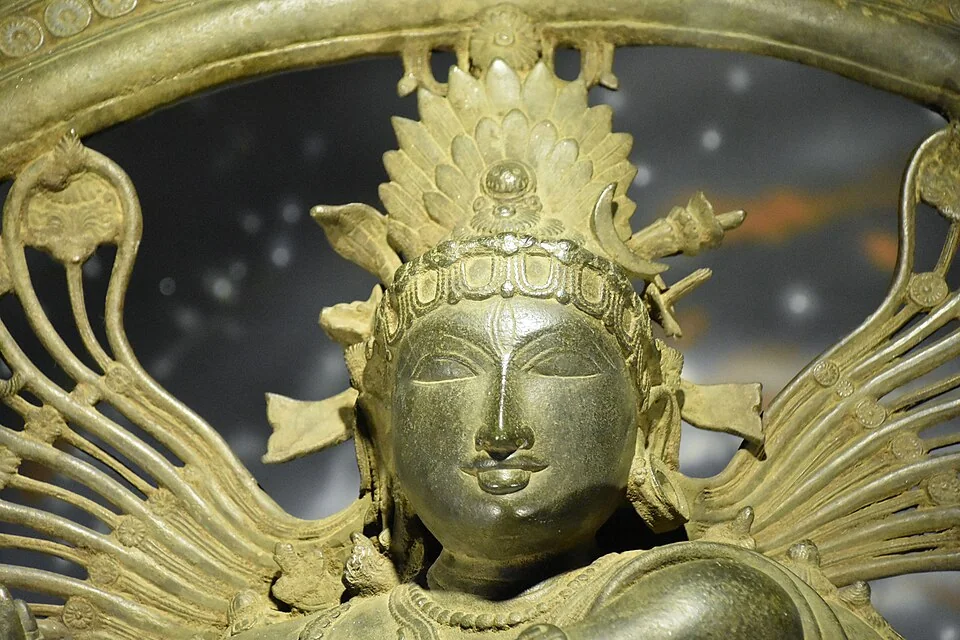
As Nataraja, Shiva dances within a ring of fire. His drum evokes creation, his flame destruction, and his raised hand reassurance. The figure beneath his foot represents ignorance, while the lifted foot offers release. The image joins cosmic activity with the possibility of liberation. Chola-period bronzes gave this theology a form carried in processions and encountered by worshippers. Metropolitan Museum of Art, Shiva as Lord of Dance.
The Nayanmars, Tamil Shaiva poet-saints, describe devotion through longing, service, song, and surrender. Karaikkal Ammaiyar is especially distinctive: her sacred biography presents her as relinquishing conventional beauty to become a skeletal devotee accompanying Shiva's dance. Her unsettling appearance expresses a religious vocation rather than evil. Metropolitan Museum of Art, Karaikkal Ammaiyar.
Vishnu and Devotional Poetry
Tamil Vaishnava traditions praise Vishnu, known in early Tamil settings as Mayon or Tirumal. His manifestations as Rama and Krishna connect Tamil devotional life with wider epic and Puranic narratives. Temples such as Srirangam cultivate particular forms of his presence, including the reclining Ranganatha.
The Alvar poet-saints address Vishnu through intense emotional relationships. Andal's poetry gives a woman's devotional voice a central place in this tradition. Divine love can be expressed through the language of bridal longing, but it also concerns service, community, and salvation. Hymns are religious performances within temple calendars, not simply literary descriptions of gods.
Village Goddesses and Guardians
Mariamman is associated with rain, disease, healing, and the welfare of communities. Her manifestations and stories vary by locality. The same goddess may be approached as a loving mother and as a dangerous power whose anger requires attention.
Aiyanar protects village boundaries and is often associated with mounted attendants and offerings of terracotta horses. His shrines connect protection with the inhabited landscape and its surrounding fields. The evidence for his worship also shows exchange between local guardian traditions and broader Hindu institutions. Metropolitan Museum of Art, discussion of Aiyanar in Lost Kingdoms.
Karuppasami, Munisvaran, and other local guardians have distinct histories and ritual followings. Their roles should not be reduced to minor versions of the major temple gods. Family deities, or kuladeivam, connect worship with kinship, ancestral places, and inherited obligations.
Ritual and Festival
Worship includes offerings, lamps, bathing and dressing images, recitation, music, and the presentation of food later received as blessed prasadam. Processions allow a temple deity to move through a community. Festivals may reenact divine marriages, battles, or visits.
Thaipusam devotion to Murugan can include carrying kavadi and fulfilling vows. The practices undertaken differ among devotees and temples. Pongal joins thanksgiving, harvested food, the sun, cattle, and household prosperity. These observances coexist with daily prayer and regional customs; no single ritual inventory describes every Tamil household.