Swahili culture developed along the eastern African coast and its islands through African histories and Indian Ocean connections. Swahili-speaking communities are diverse, and many speakers beyond the coast do not share every coastal institution. Islam is fundamental to the religious history of coastal towns, while local healing, spirit traditions, and oral literature give that history distinctive forms.
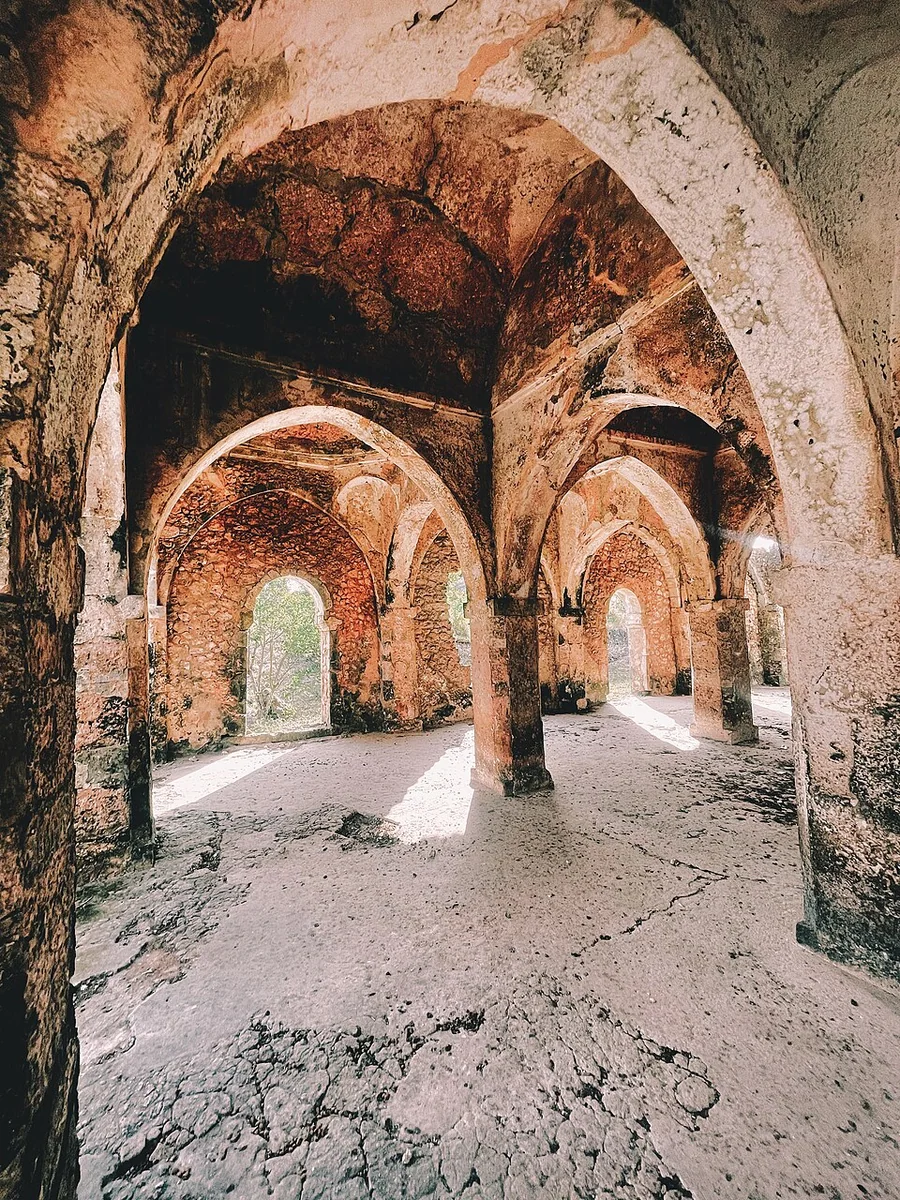

Islam and the Sacred Community
Belief in one God, reverence for the Prophet Muhammad, prayer, fasting, charity, and religious learning organize Muslim life. Mosques, Qur'anic instruction, scholars, and family observance have long connected coastal communities with wider Islamic worlds.
The presence of local spirit practices does not mean that Islam is merely a superficial layer. People debate those practices through Islamic concepts, and participants may understand them as consistent with their faith while critics reject them. Religious authority is therefore part of a continuing conversation about correct conduct.
Jinn, Pepo, and Named Spirits
Terms including jini, plural majini, pepo, and sheitani occur in descriptions of spiritual beings. Their meanings vary between settings. The Islamic category of jinn includes beings with moral differences; it should not automatically be translated as “evil demon.”
Possessing spirits may have names, preferences, languages, and social identities. Some are associated with other regions or peoples, making spirit life a way of thinking about the coast's history of movement and difference. Kjersti Larsen's work in Zanzibar examines how ritual gives these identities a setting in which humans and spirits interact. Where Humans and Spirits Meet.
Possession and Healing
A person troubled by a spirit may consult a specialist, commonly described with the term mganga. Treatment can involve diagnosis, negotiation, offerings, music, or an ongoing relationship with the spirit. Expelling every spirit permanently is not the only possible objective.
Ngoma encompasses forms of drumming, dance, and organized performance; in a healing setting it can help establish communication and recognize a possessing being. The event depends on experienced participants and social relationships rather than sound alone.
Research across coastal Kenya and Tanzania challenges the assumption that possession is only an expression of marginality or powerlessness. Its meanings depend on the participants, institutions, and local history. “Possession cults on the Swahili coast,” Africa.
Fumo Liyongo: Poet and Hero
Fumo Liyongo is a major figure in Swahili oral and literary tradition, especially associated with the northern coast. He combines exceptional physical ability with poetic skill. Stories describe rivalry with rulers, imprisonment, escape, betrayal, and a vulnerability that ordinary weapons cannot overcome.
In well-known versions, his weakness is connected with his navel and a particular kind of weapon, knowledge eventually used against him. The contrast between public strength and concealed vulnerability gives the story its tragic force.
Liyongo is not simply a god receiving worship. His narratives explore authority, kinship, eloquence, and the relationship between a community and an extraordinary individual. Versions circulate through songs, oral accounts, and written verse. Columbia University, the epic of Liyongo.
Poetry, Saints, and Religious Memory
Swahili religious poetry includes narratives about the Prophet, praise, moral instruction, and reflections on death and proper living. Performance and manuscript culture connect local language with wider Islamic learning.
Visits to graves of revered figures and commemorative gatherings have been important in some communities. Their legitimacy is debated within Islam, and practice varies. A shrine's significance may concern remembered learning, descent, blessing, or a relationship with a particular town rather than an independent deity.
Power, Misfortune, and Historical Change
Ideas about uchawi, often translated as witchcraft or harmful mystical action, can enter explanations of misfortune and unequal power. They should be described as beliefs and accusations, not treated as factual proof that an accused person caused harm.
Research in Pemba connects these ideas with political history and social relationships. Colonial government, religious reform, migration, and economic change all altered how people understood and responded to unseen power. Mystical Power and Politics on the Swahili Coast.