Slavic-speaking peoples developed religious traditions across eastern, central, and southeastern Europe. Their pre-Christian beliefs are unevenly documented, largely through Christian authors, archaeology, and later folklore. East Slavic, West Slavic, and South Slavic material should be distinguished before connections are proposed.

Modern retellings often supply a complete divine family and a continuous creation epic. The surviving evidence is more fragmentary. Some names are securely attested while elaborate stories associated with them are scholarly reconstructions or modern inventions.
Perun and Veles
Perun is strongly associated with thunder, martial authority, and solemn oaths. The Primary Chronicle describes an image installed by Vladimir in Kyiv before his conversion, with a silver head and golden moustache. This is evidence for a particular political and religious setting, not an inventory of every Slavic village shrine.
Veles, also written Volos in relevant sources, appears in oath formulas and is connected with cattle or wealth. The familiar reconstruction of Perun pursuing a serpentine Veles through the world draws on comparative folklore and linguistics. It is influential, but no surviving medieval Slavic text narrates that entire reconstructed cycle as one story. University of Bergen, medieval East Slavic literature.
Mokosh and Other East Slavic Names
The Kyiv list includes Mokosh, Khors, Dazhbog, Stribog, and Simargl alongside Perun. Mokosh's presence is securely recorded, but her exact functions require more cautious interpretation. Later associations with women's work, spinning, and moisture should not automatically become a fully documented ancient biography.
Dazhbog and Khors have been interpreted in relation to solar power, while Stribog is connected with winds in literary evidence. The identity of Simargl is debated, including proposals involving Iranian influence. A deity's inclusion in a list tells us that the name mattered; it does not establish every attribute supplied by later handbooks. University of Texas, the Primary Chronicle and its deities.
Svantovit at Arkona
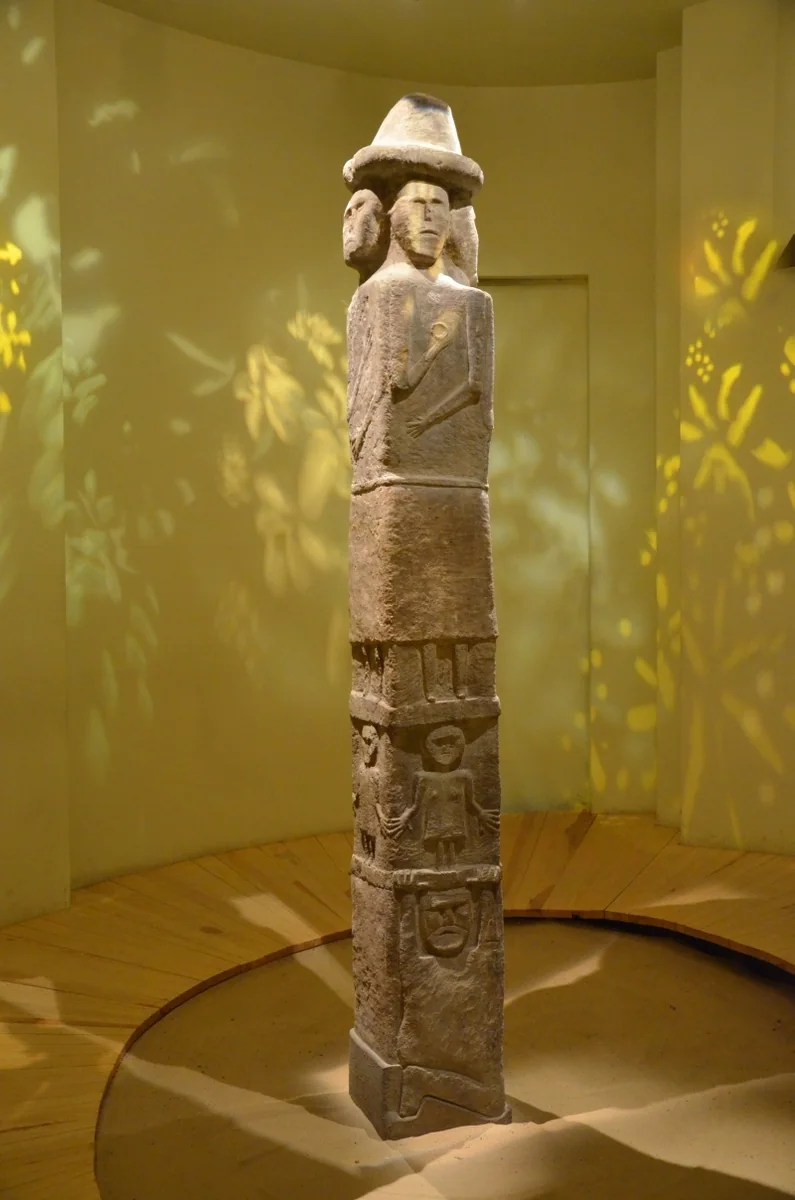
West Slavic evidence includes the sanctuary of Svantovit at Arkona on Rügen. Medieval descriptions give the image four heads and associate the cult with a drinking horn, abundant harvests, warfare, and a sacred white horse used in divination.
The horse's movements across arranged spears were interpreted before collective action. A priest's observation of the contents of the horn also concerned the coming year's abundance. These specific procedures distinguish the Arkona cult from a generalized category of thunder worship.
The account survives through Christian writers describing a sanctuary destroyed during conquest. Jan Máchal's historical survey reproduces the medieval descriptions, while its broader comparative arguments reflect the scholarship of its own period. Máchal, Slavic Mythology, Svantovit.
Household and Landscape Beings
Later folklore records beings associated with the house, forest, water, fields, and dangerous times or places. East Slavic examples include the domovoi, a household presence; the leshy, associated with woodland; and water beings known under names such as vodyanoy.
Their behaviour depends on a relationship. A household being may protect a family yet react to neglect, while a forest being can mislead someone who violates the place's expectations. These are not necessarily miniature members of the medieval Kyiv pantheon.
Rusalki likewise vary across regional traditions. They may be connected with untimely death, water, fields, seasonal ritual, and dangerous encounters. The modern image of a beautiful fish-tailed mermaid does not encompass that variety.
Baba Yaga and Other Tale Figures
Baba Yaga appears in East Slavic folktales as a frightening, testing, and sometimes assisting figure. Her forest dwelling and demanding encounters place heroes at a boundary between ordinary life and another realm. Whether she threatens or helps depends on the story and the visitor's conduct.
Koschei, often called the Deathless, is associated with concealed or externalized mortality. A hero must discover where his life or death is hidden rather than defeat him through straightforward force. Dragons and multiheaded serpents also appear as opponents, though their names and characteristics differ by language and narrative cycle.
These figures are important folklore, but evidence that a character appears in a tale is not proof that it was worshipped as a deity centuries earlier.
Seasonal Rites and Religious Change
Spring and midsummer customs, commemorations of the dead, agricultural blessings, and winter visiting traditions developed alongside Christian calendars. Older motifs could be reworked through saints and church festivals, while new practices also entered local life.
Contemporary Rodnovery and other revival movements interpret the fragmentary evidence in different ways. Their beliefs are living religious choices. They should be identified as contemporary interpretations where they extend beyond what medieval sources securely establish.