Sinhala religious life in Sri Lanka is strongly associated with Theravada Buddhism, but includes a range of practices involving protective deities, planetary powers, and spirits. These are not necessarily experienced as separate religions. Their relationships depend on local institutions, teachers, families, and the purpose of a particular observance.
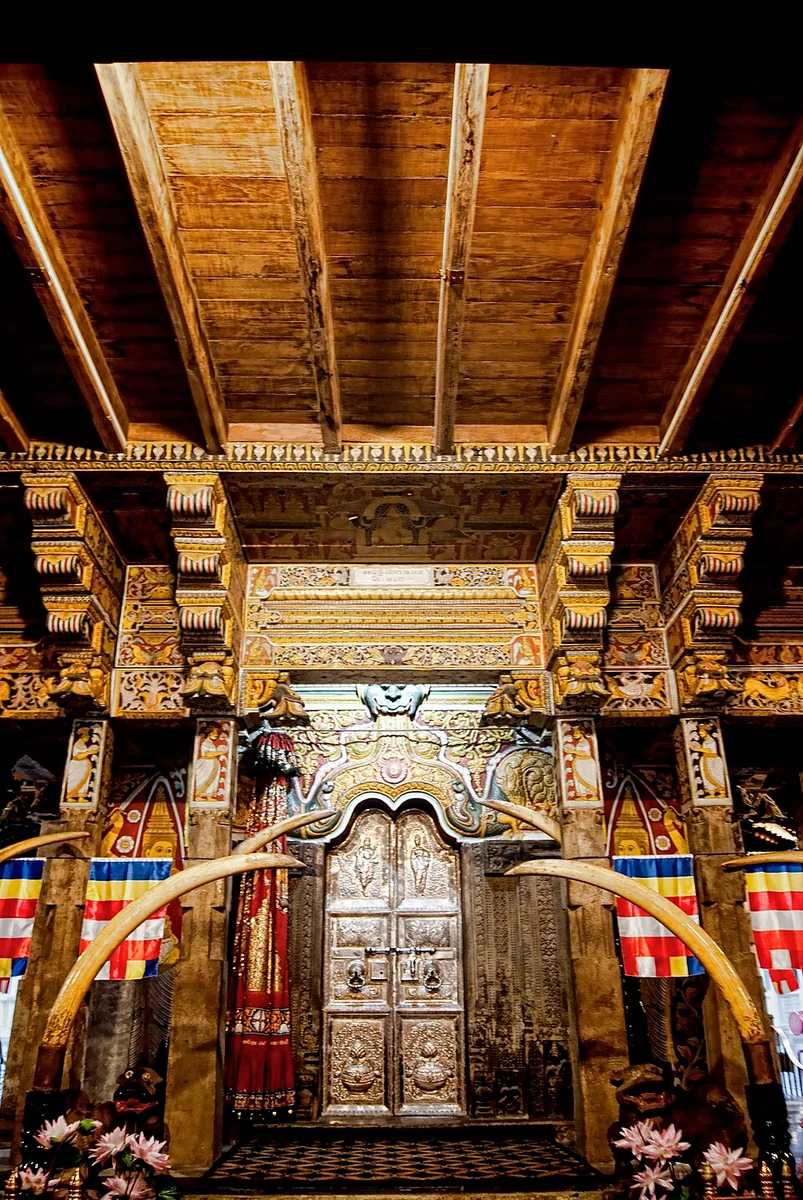

The Buddha and Other Sacred Powers
The Buddha is an awakened teacher whose path concerns liberation from suffering. He is not ordinarily treated as a creator god. Deities can be honoured for protection and worldly assistance while remaining within the cycle of rebirth and below the Buddha in religious understanding.
This distinction allows different kinds of practice to address different needs. Giving to monks, observing ethical precepts, and meditating need not serve the same immediate purpose as making a vow at a deity shrine. Anthropological study cautions against assuming that only one of these activities constitutes “real” Sinhala Buddhism. Premakumara de Silva, anthropology of Sinhala Buddhism.
Protective Deities
Saman is associated with Sri Pada and its surrounding region. The mountain's sacred footprint has different interpretations among religious communities; in Buddhist devotion it is connected with the Buddha. Pilgrimage gives the mountain a religious importance that exceeds a single local shrine.
Vishnu is honoured in Sinhala Buddhist contexts as a protective power, while Natha and Vibhishana also have important histories of worship. Their relationships with Hindu traditions do not make every Sri Lankan observance identical to one in India. Lists of the island's principal guardian deities have varied over time. Account of popular Sinhala religion.
Kataragama
Kataragama deviyo is a powerful figure associated with the shrine complex at Kataragama. Hindu devotees identify the deity with Skanda or Murugan. Buddhist, Hindu, Vedda, and Muslim traditions have distinct relationships with the wider sacred landscape.
Vows, offerings, pilgrimage, and the annual festival bring personal needs into a public setting. Historical accounts connect the deity with protection in conflict and with royal patrons. M. D. Raghavan's study discusses the interwoven histories of divine figures and local ritual at the shrine. “The Ceylon Shrine of God Kadira”.
Pattini and the Power of Fidelity
Pattini is associated with protection, fertility, health, and the moral force of a wronged woman. Her traditions are related to the Tamil story of Kannaki, whose husband is unjustly executed and whose righteous anger destroys a city. Sinhala narratives and rituals give the figure their own forms.
Her power includes both nurture and punishment. The story links bodily and social well-being with justice rather than depicting the goddess as simply mild or benevolent. Community ceremonies can seek her protection against illness and other collective dangers.
Yakku and Healing Performance
Yakku, singular yakka, are beings commonly translated as demons, although that English word can impose an overly simple moral interpretation. Their involvement in illness may be addressed through ritual specialists who negotiate, command, dramatize, or transform a dangerous relationship.
Sanni Yakuma concerns a group conventionally associated with eighteen diseases. Masks distinguish particular afflictions and characters, and the performance includes speech, movement, music, and dramatic interaction. The Australian Museum's collection demonstrates the variety of masks within this healing tradition. Daha Ata Sanniya masks.
The mask is one component of an event, not a complete ritual in itself. A figure that appears frightening in a display can have a role involving humour, recognition, and the reduction of fear when performed before a community. The Science Museum likewise identifies disease masks through their use in healing rites. Science Museum Group, ritual mask.
Ritual Genres and Everyday Life
Tovil refers broadly to forms of spirit-related ritual, while kolam includes masked dramatic entertainment. They can share visual and performative resources without being the same event. Planetary rites and ceremonies addressing particular local powers add further complexity. Museu da Marioneta, Sri Lankan masks.
Contemporary people make different choices about these practices. Some emphasize canonical Buddhist teaching and reject spirit rites; others maintain family or community obligations alongside temple life. Historical and regional differences are therefore necessary to any account of Sinhala belief.