Sardinia's religious history includes prehistoric communities, Nuragic societies, Phoenician and Punic settlement, Roman rule, and many centuries of Christianity. These periods left related landscapes but not a single recoverable “Sardinian pantheon.” Later folklore can give an ancient monument a new meaning without preserving its original purpose unchanged.

Sacred Water and Nuragic Sites
Nuragic sacred wells and springs show the importance of water in ceremonial life. Their carefully constructed access routes, chambers, and associated offerings indicate organized activity at places where communities encountered an essential resource.
The sanctuary of Janna 'e Pruna and the nearby sacred well of Su Notante are examples documented by the regional tourism authority and local museum. Archaeology establishes the sites' material arrangements more securely than it establishes the personal names or stories of the powers once invoked there. Sardinia, Irgoli antiquarium.
At other sites, later Roman use continued or reinterpreted the religious significance of water. The Alghero museum describes a Nuragic well reused in rites concerned with healing. Continuity of place does not necessarily mean that the same deity or ritual survived without alteration. Alghero Archaeological Museum, the sacred world.
Sardus Pater and Antas
Sardus Pater was worshipped at Antas in the Roman period. The surviving temple dedication makes his divine identity clearer than those of many prehistoric powers. The sanctuary's history also includes the Punic god Sid and earlier local use.
The National Archaeological Museum of Cagliari interprets Sardus Pater as an Indigenous divinity connected with the transformation of Sid's cult. This is evidence for the historical negotiation of religious identities, not a reason to merge every Sardinian god into one figure. Cagliari museum, Fluminimaggiore and Antas.
Janas and the Houses of Fairies
Janas are beings of Sardinian folklore commonly translated as fairies. Their stories attach extraordinary inhabitants to caves, rocks, and small openings. The term domus de janas, houses of the fairies, is now used for prehistoric rock-cut tombs.
Those tombs were made for the dead, not built as homes for tiny supernatural women. The later name records a different way of explaining visible remains after the circumstances of their construction had been forgotten. It is an important example of folklore interpreting archaeology. Sardinia, houses of the fairies.
At the Is Janas cave near Sadali, local legend identifies imposing stalagmites with transformed janas. The story ties supernatural action to features visitors can still see. It should be understood as a local narrative rather than the biography of a goddess worshipped across the island. Sardinia, Is Janas.
Masks and Seasonal Performance
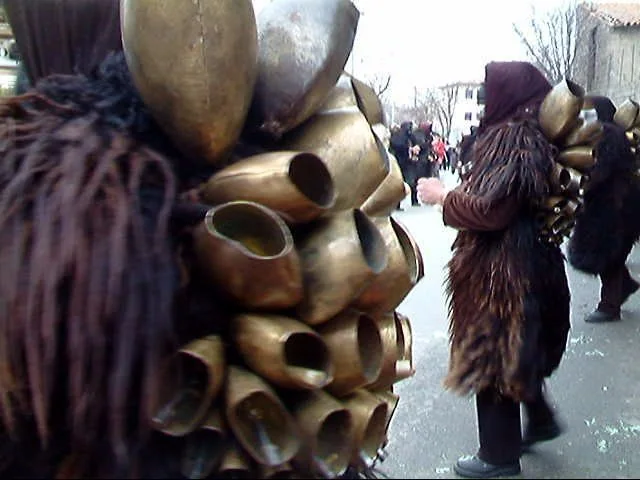
The Mamuthones and Issohadores of Mamoiada are distinctive masked figures. Heavy bells, dark masks, costume, movement, and the contrasting roles of performers make the event recognizable. Other communities maintain different traditions, including the Boes and Merdules of Ottana and the Thurpos of Orotelli.
The Mediterranean Masks Museum presents these forms together while preserving their local identities. Their origins are debated: suggestions involving agricultural renewal, pastoral life, domination, or ancient ritual are interpretations, not a deciphered original script. Mamoiada museum system.
Catholic Life and Vernacular Belief
Saints' festivals, processions, vows, and pilgrimage have shaped Sardinian communal life for centuries. Local stories and protective customs can operate within this Catholic environment rather than representing a separate secret religion.
Concern with harmful looks, misfortune, healing, and encounters with the dead appears in regional folklore. The details depend on locality and family transmission. Treating every such custom as a direct survival from Nuragic times erases the intervening histories through which people learned and changed their practices.
Objects, Stories, and Historical Layers
Bronze figures, tombs, wells, and temples supply evidence of acts, materials, and settings. They rarely identify a complete narrative by themselves. Later tales, meanwhile, explain how communities understood places in their own historical circumstances.
Keeping these kinds of evidence distinct permits more informative comparisons: the religious use of a spring can be ancient, the name attached to its supernatural inhabitant much later, and its present festival connected with a Christian saint. Each belongs to Sardinian history without requiring all three to have one unchanged origin.