Samoan traditions connect islands, chiefly titles, family relationships, and sacred places with the actions of divine and ancestral beings. Their transmission belongs to particular villages, families, and speakers. Christianity is central to contemporary Samoan religious life, while older narratives continue in genealogies, place-names, performance, and historical memory.
.jpg)
Tagaloa and Creation
Tagaloa is a major creative figure. In a narrative recorded by Lyell and Ellen Holmes and published by the National Park Service, he establishes islands and arranges their inhabitants. Manu'a has a particularly important place in this account.
Creation explains relationships between communities as well as the existence of land. The story's distribution of people and authority makes geography a social and sacred order. Other Polynesian traditions have related names—Tangaroa and Ta'aroa—but their roles and stories should not replace the specifically Samoan account. National Park Service, Samoan creation legend.
Nafanua and the Exercise of Power
Nafanua is a powerful female figure associated with war, victory, and chiefly authority. Her father is Saveasi'uleo, connected with Pulotu, and her mother is Tilafaiga in widely recorded genealogies. Narratives of her unusual birth and emergence establish a power that ordinary expectations initially fail to recognize.
She becomes a decisive actor in conflict, and the distribution of titles and authority is connected with her deeds. Her significance is therefore political and genealogical as well as martial. A Harvard discussion of Samoan lineage emphasizes the continuing relevance of her story to the interpretation of chiefly relationships. Harvard Center for the Study of World Religions.
Accounts preserved in Falealupo also connect Nafanua with responsibilities toward plants and the environment. Paul Alan Cox records local teaching about her through a named storyteller, illustrating the value of identifying the people through whom a narrative is transmitted. Paul Alan Cox, Nafanua.
Saveasi'uleo and Pulotu
Pulotu is a realm associated with the dead and divine power. Saveasi'uleo rules there and is described in some traditions with a human upper body and an eel-like lower body. His form links different domains of existence rather than following ordinary human anatomy.
A shared Polynesian word for an otherworld does not establish identical afterlife teachings across all islands. Samoan accounts of Pulotu belong to particular genealogies and places, including the importance of western Savai'i in traditions of the dead.
Sina and the Eel
In the National Park Service's version of Sina and the eel, a powerful Fijian ruler changes into an eel to seek Sina. She initially cares for the small creature, but its growth and pursuit become troubling. The eel eventually directs her to bury its head, from which a coconut palm grows.
The features of the coconut are explained through the eel's face, connecting a familiar food with a story of desire, transformation, danger, and remembrance. Versions vary across the Pacific; this particular telling should not be imposed on every tradition involving Hina or Sina and a water creature. National Park Service, Sina and her eel.
Aitu, Families, and Places
Aitu is a broad term for spiritual beings whose identities and relationships depend on context. Historical accounts describe family or village associations with particular animals and powers. A species might be treated with special care because of such a relationship, without implying that all Samoans worshipped all animals in the same way.
Stories of encounters can explain a spring, a rock, an abundance of fish, or a restriction. They establish what a place means to its people and how visitors should behave there.
Ceremony and the Gift of Food
The National Park Service records a Fagasa tradition connecting the arrival of atule fish with Sina and Liava'a. The fish's appearance is associated with gratitude, remembered persons, and chiefly responsibility. An 'ava ceremony acknowledges the bounty and places harvesting within a social and sacred relationship. Natural History Guide to American Samoa.
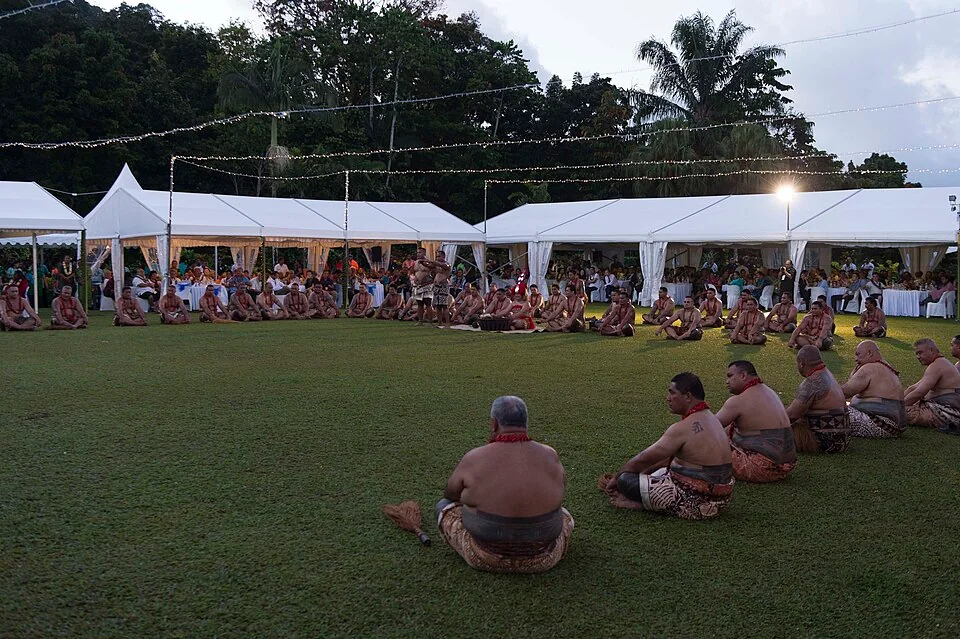
'ava ceremonies also express rank, hospitality, and the ordering of relationships. Their significance cannot be reduced to drinking a plant preparation. Who prepares, distributes, receives, and speaks matters to the ceremony.
Christian and Ancestral Histories
Nineteenth-century Christian conversion transformed public worship and religious leadership. Churches became major institutions of village life. Yet conversion did not make oral history, chiefly genealogy, and named landscapes irrelevant.
The same narrative can now be approached as family history, literature, cultural education, or a statement about sacred power. Its meaning depends on the speaker and occasion, and contemporary Samoans do not all interpret inherited stories in the same way.