The Sámi are Indigenous peoples of Sápmi, a region extending across northern Norway, Sweden, Finland, and Russia. Their languages, livelihoods, and histories differ. Reindeer pastoralism is important in many communities but does not define all Sámi life, and religious traditions likewise cannot be reduced to one uniform system.

Historical descriptions often come from missionaries or court proceedings against religious practitioners. They preserve valuable information while reflecting attempts to suppress the practices being described.
Sacred Landscapes and Sieidi
A sieidi, with related terms in different Sámi languages, is a sacred place or feature associated with relationships to spiritual power. Distinctive stones, cliffs, and other landscape forms could receive offerings. Their importance depended on particular people, activities, and places rather than a general rule that every unusual rock was sacred.
Offerings connected successful hunting, fishing, or herding with obligations beyond the human community. The Sámi museum RiddoDuottarMuseat includes both sieidi and objects connected with religious practitioners in its collections, locating them within Sámi cultural history. RiddoDuottarMuseat collections.
Beaivi and Heavenly Powers
Beaivi, the sun, has a central life-giving role in many accounts. The return of light and warmth matters profoundly in northern environments. Traditions connecting reindeer with sunlight express relationships among celestial power, animals, and human survival.
Thunder is associated with figures known by names such as Horagállis and Dearpmis. Names and iconography vary, and some recorded forms reflect contact with neighbouring Scandinavian traditions. It is therefore preferable to identify a local source rather than combine every recorded name into a single canonical genealogy. Store norske leksikon, Sámi religion.
Mothers, Birth, and the Household
Historical accounts describe Máttaráhkká and female powers commonly written Sáráhkká, Uksáhkká, and Juoksáhkká. Their functions concern the formation, birth, and protection of children. Sáráhkká is especially associated with childbirth and the hearth, while the other figures have roles connected with the doorway and the child's development.
These powers locate religion within domestic life and reproduction, not only in the exceptional work of a ritual specialist. Offerings of food and drink acknowledged their assistance. The precise allocation of functions differs among recorded accounts and language areas. Bo Lundmark, study of a Sámi drum and its figures.
Noaidi and the Drum
A noaidi was a specialist able to work with spiritual powers in matters such as illness, danger, and the recovery of knowledge. Helping beings, performance, and trained relationships were important to the role. “Shaman” is a comparative term and should not erase the local vocabulary.
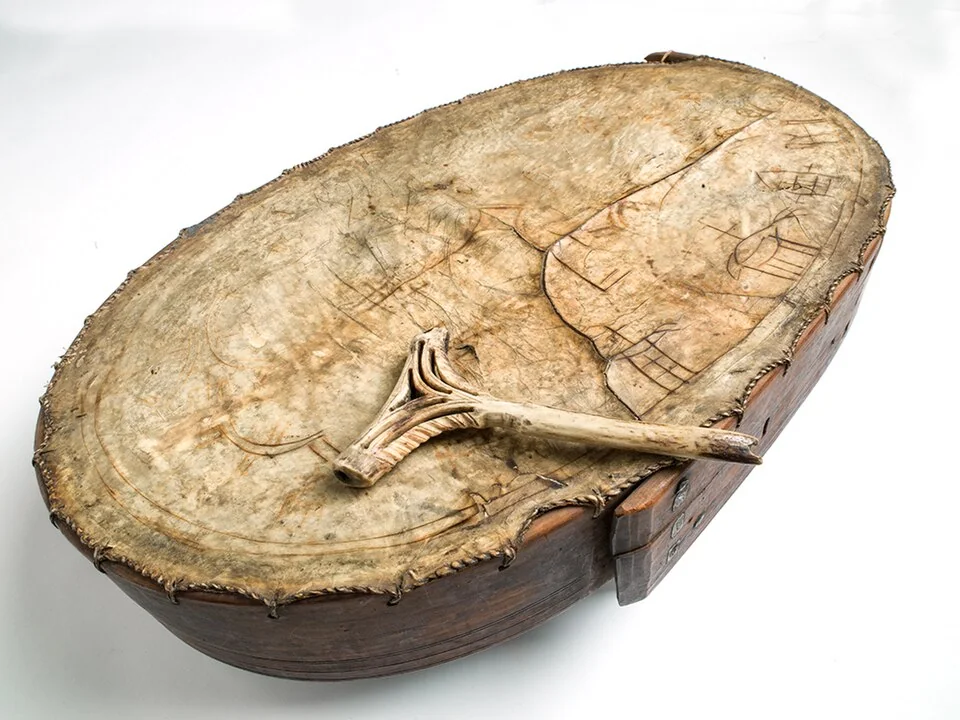
Drums carried images whose arrangements could represent relationships among worlds, beings, and human activities. They were used in different ways, including divinatory practices. Not every drum shares an identical design, and not every historical user had the same specialist status.
The drum associated with Anders Poulsen, whose beliefs were questioned in a 1692 legal case, is especially significant because a recorded explanation accompanies it. Even this unusual evidence is shaped by interrogation and translation rather than an unrestricted account given under neutral conditions.
Animals and Storytelling
Animals can be partners, sources of knowledge, or beings whose treatment affects future relations. Bear-related observances are documented in historical Sámi sources, but their details differ and cannot be assumed to have remained unchanged across Sápmi.
Folktales also include Stállu, a threatening and often outwitted figure. The cleverness of a human opponent can defeat superior size or strength. Such stories are not automatically descriptions of beings receiving ritual worship; folklore, sacred narrative, and everyday instruction overlap without being identical genres.
Christianity, Suppression, and Continuing Knowledge
Christian conversion occurred through long and uneven processes. Drums were confiscated, specialists prosecuted, and practices reclassified as superstition. Lutheran and Orthodox histories differ across the region, and Sámi Christians also developed their own forms of religious expression.
Museums, language work, oral history, and the return of belongings contribute to contemporary discussion of inherited knowledge. The Sámi Museum Siida describes its work as that of an Indigenous museum, making community authority central to interpretation. Contemporary Sámi people may be Christian, follow Indigenous religious practices, hold other beliefs, or identify with no religion. Sámi Museum Siida.