The Sakha, also known as Yakuts, are a Turkic-speaking people whose homeland lies in northeastern Siberia. Horse and cattle husbandry, life along major rivers, and relationships with a demanding seasonal environment shape their cultural history. Their religious traditions include inherited spirit practices, Russian Orthodoxy, and contemporary Indigenous religious organization.

Worlds and Sacred Powers
Accounts frequently distinguish an upper world, a middle world inhabited by people, and a lower world. These domains are populated by different powers, but their arrangement varies between narrative and ritual contexts.
Ürüng Aiyy Toyon, written in several transliterations, is a high creative figure associated with brightness and the upper world. The aiyy are beneficent divine powers, while abaahy commonly appear as dangerous or hostile beings. A Columbia University interpretation developed with Sakha collaborators emphasizes that these categories belong to a more complex world than a simple diagram of heaven, earth, and hell. Sakha shaman: a healing ritual.
Ichchi and the Agency of Places
Ichchi are spirit owners or presences associated with places, things, and activities. A landscape is therefore not religiously empty between major shrines. Trees, waters, household settings, and other features can require respectful conduct.
Susan Crate's work also discusses the spiritual efficacy attributed to words. Speech can bless, harm, and carry consequences beyond the moment of utterance. This gives particular importance to careful language and to the verbal artistry of ritual and performance. University of Arizona Press, Once Upon the Permafrost.
Olonkho and the Heroic World
Olonkho names a tradition of long heroic narratives as well as individual works within it. A performer alternates recited passages with sung character speech, differentiating human and supernatural voices. The narratives concern the establishment and defence of human life amid conflicts involving otherworldly beings.
Heroes travel, encounter powerful opponents, and form relationships essential to the continuity of their people. Their deeds are situated within richly described landscapes and genealogies. Olonkho is therefore an art of performed knowledge, not merely a prose plot that can be detached from its language and sound. UNESCO, Olonkho.
The world tree and the nourishment or protection associated with it are important epic images. Modern Sakha artists continue to interpret the upper-world powers and heroic landscapes. The National Library of the Sakha Republic presents these images within a living tradition of illustration and cultural memory. National Library, The Olonkho Land.
Yhyakh and Blessing
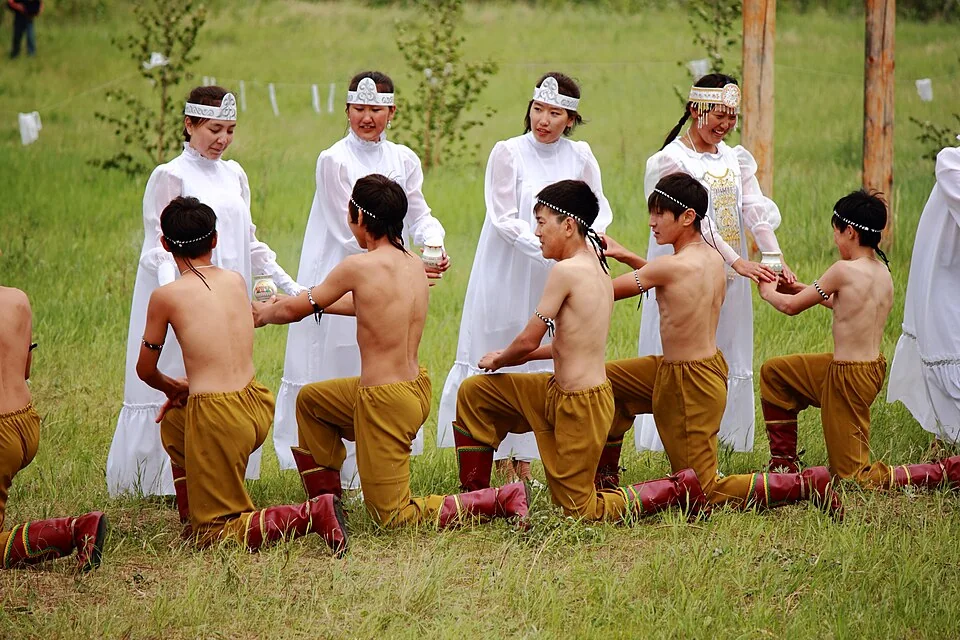
Yhyakh is a major summer gathering associated with renewal, blessing, hospitality, and the prosperity of people and animals. Offerings, the sharing of fermented mare's milk, and communal performance connect the event with the seasonal return of abundance.
Algys, blessing speech, and the circle dance ohuokhai are significant forms of participation. Their force lies partly in collective action and the spoken or sung word. A blessing specialist and a healer may have different responsibilities; placing every participant under the single label “shaman” conceals those distinctions.
Contemporary research shows that Yhyakh can be understood as a religious occasion, an Indigenous festival, a civic celebration, or several of these at once. Those categories are debated by participants and institutions, rather than settled by an outsider's definition. Research on religion and indigeneity at Yhyakh.
Healing and Historical Change
Healing specialists historically negotiated relationships with spirits implicated in illness. Instruments, clothing, movement, and sound formed parts of the work, but a museum display records only selected material features of a practice involving knowledge and relationships.
Russian missionization and Soviet anti-religious policies changed what could be publicly performed and transmitted. Festivals were sometimes reframed in secular terms, while families retained differing amounts of ritual knowledge. Contemporary revival includes debate about authority, authenticity, and the relation of inherited traditions to Christianity. These debates are part of Sakha religious life rather than evidence that the culture has only one correct modern form.