Roman religion developed over many centuries, from the communities of central Italy to an empire spanning the Mediterranean and beyond. Its traditions incorporated Latin, Etruscan, Greek, and many other influences. Roman authors retold Greek myths extensively, but Roman religious life cannot be understood simply by replacing Greek divine names with Latin ones.
,_2nd_century_AD,_Staatliche_Antikensammlungen,_Munich_(8957204633).jpg)
Gods, Communities, and Correct Action
Worship maintained relationships among gods, households, and the state. Prayer, vows, offerings, festivals, and the proper interpretation of signs mattered alongside stories about divine personalities. The expression pax deorum, the peace or favourable relationship with the gods, conveys the public importance of those obligations.
There was no single creed required of every worshipper. Particular priesthoods and communities preserved specialized procedures, while philosophers and poets could debate the gods' nature. Religious diversity did not mean that public observances were considered optional or without consequences.
Major Deities
Jupiter, Juno, and Minerva
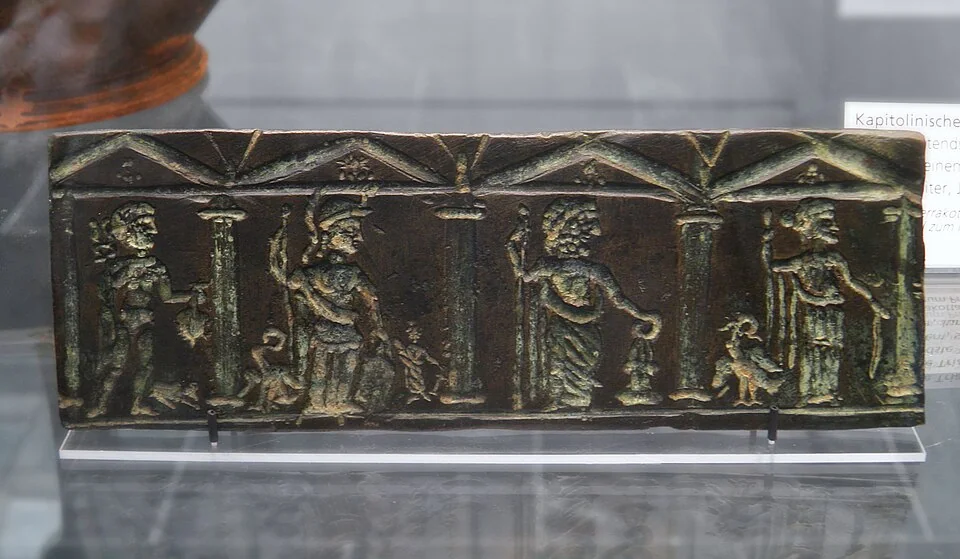
Jupiter Optimus Maximus presided over a major temple on the Capitoline Hill with Juno and Minerva. His authority encompassed sovereignty, oaths, thunder, and the security of the Roman state. Triumphing generals approached him in a ceremony linking military success to divine favour.
Juno's functions included marriage, women, and the protection of civic life. Different titles identified particular relationships, such as Juno Regina or Juno Moneta. Minerva was associated with skilled work, learning, and protective intelligence. Their joint Capitoline worship was a Roman institution, not merely a literary gathering of Zeus, Hera, and Athena under new names. Metropolitan Museum, Roman Art.
Mars and Venus
Mars was a protector of the community and a central power in warfare. His relationship with agriculture and boundaries complicates the idea that he was concerned only with fighting. As the father of Romulus and Remus, he also belonged to Rome's founding genealogy.
Venus concerned attraction, generation, and the ancestry claimed through Aeneas. Julius Caesar and Augustus gave that ancestry particular political prominence. Literary stories about Venus's relationships coexist with civic cults such as Venus Genetrix, whose title emphasizes generative and ancestral authority.
Janus and Vesta
Janus presides over beginnings, transitions, and doorways. His two faces express his capacity to look in different directions. Ovid's Fasti presents him explaining the opening of the year and the religious significance of entry, departure, and first acts. His Roman identity has no exact Greek equivalent. Ovid, Fasti, book 1.
Vesta's sacred fire represented the continuity of the community. The Vestal Virgins maintained it under distinctive rules and privileges. Their priesthood was a public institution with major responsibilities, not simply domestic housekeeping enlarged to state scale. Ovid associates Vesta with the hearth and explores the absence of a conventional statue within her sanctuary. Ovid, Fasti, book 6.
Ceres, Diana, Mercury, and Other Powers
Ceres is associated with grain, cultivation, and the conditions of nourishment. Diana concerns hunting and other aspects of wild and human life; her worship at different sites had different local emphases. Mercury is connected with exchange, movement, and commerce. Neptune concerns waters, while Vulcan's fire can be productive and dangerously destructive.
Saturn's remembered reign represents an earlier order whose abundance and reversals of hierarchy are recalled at the Saturnalia. Faunus, Silvanus, nymphs, and numerous local powers connect worship with fields, woodland, springs, and the boundaries of settlement. A divine title can specify a function without necessarily naming an entirely separate god.
Founding Heroes and Violent Origins
Aeneas escapes the destruction of Troy carrying obligations to family and gods into a new homeland. In Virgil's Aeneid, his duty produces both achievement and suffering, including the abandonment of Dido and war in Italy. Rome's future emerges from loss and conflict rather than an uncomplicated adventure.
Romulus and Remus, sons of Mars and Rhea Silvia, survive exposure and are nourished by a she-wolf in the best-known version. Their dispute over the new city ends in Remus's death. The founding story therefore places fraternal violence at the beginning of Rome's political order.
Romulus later disappears and is associated with the god Quirinus in important traditions. Numa, the next king in the conventional sequence, embodies religious organization and the establishment of rites. Ovid's account of March joins Mars, the twins, and Roman calendrical memory. Fasti, book 3.
Household Spirits and the Dead
Lares protected households and other social spaces, including neighbourhoods. Penates were connected with the household's provisions and continuity. The genius expressed a generative or protective dimension of a person or group; these concepts are not all interchangeable labels for ghosts.
The dead were honoured through funerals, tomb visits, food, and calendrical observances. Di Manes appears in funerary dedications. Other rites addressed potentially troubling dead, revealing that remembrance included both care and concern about unsettled relationships.
Afterlife images varied. Greek-derived underworld stories, philosophical arguments, family commemoration, and hopes associated with particular cults did not form one universally agreed Roman doctrine.
Sacrifice, Divination, and the Calendar
Public sacrifice involved the selection of an appropriate victim, prayer, offerings, inspection, and the distribution of portions. Plant foods, wine, incense, and other materials also had religious roles. Ritual precision mattered because an error could require repetition.
Augurs interpreted auspices, including signs connected with birds, within recognized procedures. Haruspices drew on Etruscan traditions of interpreting entrails and other signs. Neither practice was simply an individual's unrestricted prediction of the future.
The calendar organized festivals, temple anniversaries, and days appropriate for particular kinds of public activity. Ovid's Fasti is valuable precisely because it preserves multiple explanations and competing stories for these observances; it is a poetic investigation rather than an official ritual manual.
Empire and Religious Change
The worship of Isis, the Magna Mater, Mithras, and many local deities developed within Roman territories. Imperial cults expressed relations with rulers and the state, with significant variation between cities and provinces. Some emperors were deified after death, while living rulers could receive different kinds of honours.
Christianity emerged and expanded within this changing religious environment. Its eventual imperial support transformed temples, public ritual, and the legal standing of other cults over time. That long transition should not be compressed into a single moment when all Roman religious practices ended.