Rapa Nui is the Indigenous name of the island also known as Easter Island and of its people. Its religious traditions developed within the Polynesian world while taking distinctive forms in an isolated island environment. The monumental moai, wooden carvings, rock art, and oral histories illuminate different periods and practices; they should not be combined into a single unchanging religion.

Ancestors and Moai
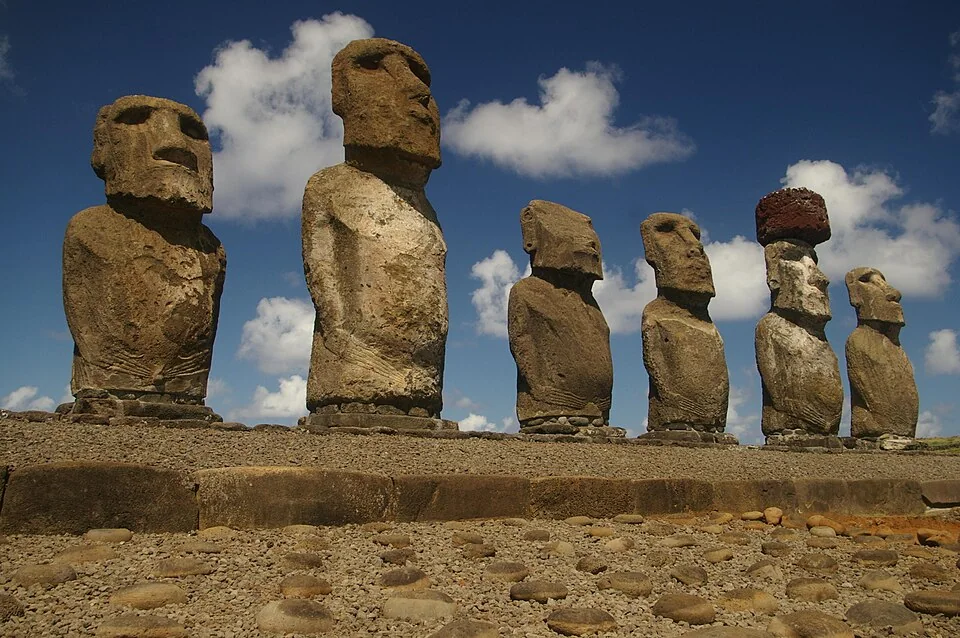
Moai represent powerful ancestors. Many stood on ceremonial platforms called ahu, making ancestral presence part of the landscape of communities and their descendants. Their religious importance is not explained by treating them as mysterious objects whose makers are unknown.
The figures were created by Rapa Nui people using local knowledge, labour, and organization. Their association with ancestral power connects stone, genealogy, land, and the continuing welfare of the community. American Museum of Natural History, moai.
Rapa Nui voices in the Australian Museum's interpretation describe moai as living ancestors with continuing significance. This perspective is especially important when discussing figures removed to overseas collections: the objects retain relationships that do not end when a museum acquires them. Australian Museum, Hoa Haka Nana'ia.
Makemake and the Birdman Tradition
Makemake is associated with creation, fertility, and the religious complex centred on the tangata manu, or birdman. At the ceremonial village of Orongo, participants and their representatives took part in an arduous competition connected with obtaining the first egg of a seabird from an offshore islet.
The successful participant's patron received a special sacred status. The competition joined political authority with religious power, bodily danger, seasonal birds, and the sea. It was not merely a sporting event staged beside religious monuments.
Rock carvings at Orongo depict birdmen and other motifs associated with this complex. The Rapa Nui museum presents the site as evidence of a historically specific ceremonial tradition. Museo de Rapa Nui, island heritage.
Changing Uses of Sacred Images
Hoa Hakananai'a illustrates the difficulty of assigning an object to only one religious moment. Its original moai form belongs to ancestral monument traditions, while carvings on its back connect it with birdman imagery and its later placement at Orongo.
The relationship between ancestral practices and the birdman complex involved historical change, not necessarily a single abrupt replacement everywhere on the island. The British Museum's account distinguishes these phases in the history of the figure and records its removal in 1868. British Museum, moai and their histories.
Wooden Figures and Supernatural Beings
Moai kavakava are wooden figures with conspicuous ribs and emaciated bodies. They differ markedly from the monumental stone ancestors. Oral interpretations connect carved figures with encounters involving extraordinary beings, but the surviving documentation does not establish one meaning for every example.
Moai tangata are more naturalistic male figures. The Metropolitan Museum notes uncertainty about their precise use while identifying ancestors or supernatural beings as probable subjects. Other carvings combine human and lizard features. These forms demonstrate that Rapa Nui sacred imagery extended far beyond the familiar large stone heads. Metropolitan Museum, moai tangata; Art and History Museum, Rapa Nui carvings.
Settlement Narratives and Sacred Knowledge
Oral histories associated with Hotu Matu'a describe the arrival of a founding leader and the establishment of people on the island. Genealogies and named places connect those narratives with claims to land and ancestry. Versions recorded after devastating nineteenth-century disruptions must be read with attention to their tellers and circumstances.
The rongorongo inscriptions remain undeciphered. They cannot currently supply a securely translated creation narrative or a catalogue of gods. Confident claims to read complete mythological accounts from them exceed the scholarly evidence.
Ritual Memory and Contemporary Life
Slave raiding, introduced disease, missionary activity, land dispossession, and colonial rule profoundly affected religious transmission. Catholic practice became established, while ancestral places, language, performance, and family histories continued to matter in changing ways.
Debates over the return of moai concern these continuing relationships. For descendants, an ancestor held overseas is not only an example of archaeological style; its location can affect the responsibilities linking people, ancestors, and the island.