Quechua names a family of languages spoken by diverse Andean peoples. It is not interchangeable with “Inca”: the Inca state used Quechua widely, but Quechua-speaking communities existed beyond its ruling population and continue across several countries. Religious practice varies by locality, history, and family.

Pachamama and Mountain Persons
Pachamama is commonly translated as Mother Earth, though pacha can connect space, time, and an ordered world more broadly than the English word “earth.” Offerings acknowledge dependence on the land and the obligations involved in cultivating, building, and consuming its products.
Apus are powerful mountain beings in many southern Andean traditions. A mountain may protect a locality, own animals, or participate in relationships with other mountains and communities. It is therefore more than a symbol selected to represent an abstract deity.
At Ausangate, religious relationships with the mountain and its glaciers remain part of contemporary life. Changing ice conditions have affected practices associated with pilgrimage, showing that sacred landscapes are also environments whose physical changes people observe closely. UNESCO Courier, traditions and glacier change.
Inca State Deities
Inti, the sun, held a prominent place in Inca royal ideology. The ruler's relationship with the sun supported claims of ancestry and authority. Mama Quilla, the moon, was associated with calendrical reckoning and royal feminine power. Illapa concerned thunder, lightning, and rain.
Viracocha appears in colonial accounts as a creator and ordering figure, but the narratives are not completely consistent. Some describe the making and distribution of peoples, while others emphasize a traveller whose actions transform places. The Inca state incorporated many local sacred powers rather than simply replacing all of them with a small official pantheon. See also Andean mythology.
The Huarochirí Manuscript
The early colonial Huarochirí Manuscript, written in Quechua, preserves traditions of a region near Lima. It is especially valuable because it records local sacred narratives rather than only the religion of the Inca court. It was nevertheless produced in the context of campaigns against Indigenous worship.
Pariacaca, Cuniraya, Chaupiñamca, and other huacas appear in its narratives. Huaca, or wak'a, may refer to a powerful being, place, or object; translating it only as “idol” reproduces the polemical vocabulary of missionaries.
Pariacaca's contests and interventions connect political relationships with rain, mountains, and the landscape. Chaupiñamca's traditions foreground feminine power and the organization of gender, while Cuniraya's episodes involve disguise, desire, and transformation. Their personalities belong to local narratives, not to a uniform Quechua divine family. Salomon and Urioste, The Huarochirí Manuscript.
Offerings and Reciprocity
Offerings may include coca leaves, drink, food, and carefully arranged materials prepared for a specific recipient and occasion. The purpose is to maintain or repair a relationship. A mountain, the land, and a household's dead are not necessarily approached in the same way.
Religious specialists possess knowledge of places, invocations, and the conditions under which an offering is appropriate. Their work should not be reduced to a generic category of “shamanism” that ignores Andean terminology and local responsibilities.
Reciprocity also has practical dimensions. Labour exchange, hospitality, and responsibility to relatives can provide a social setting for religious obligations, although no single English concept captures every local institution.
Qoyllurit'i and Catholic Sacred Life
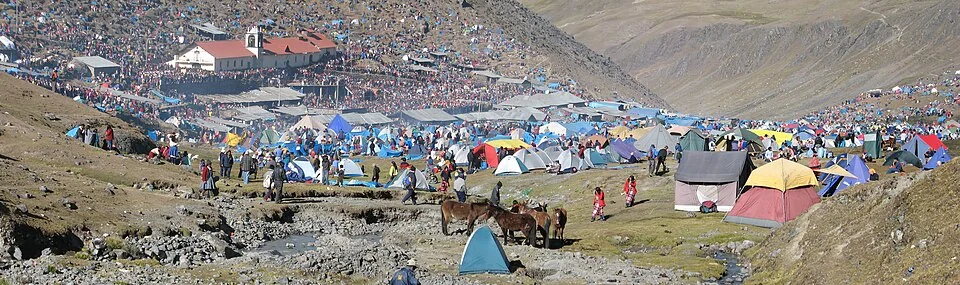
The pilgrimage to the Lord of Qoyllurit'i brings groups to a high Andean sanctuary. Catholic devotion, dance, mountain relationships, and the organization of participating “nations” form part of the same event. Figures called pablitos or pabluchas have responsibilities for maintaining order.
UNESCO's account identifies organized bodies that direct the pilgrimage and preserve its rules. The observance is therefore not an informal mixture of two religions without structure. Participants inherit and negotiate specific roles within a complex religious institution. UNESCO, Qoyllurit'i pilgrimage.
Ancestors and Local Memory
Remembered ancestors, founding places, and sacred histories can establish relationships between a community and its territory. Stories identify why a spring, rock, or mountain matters and what conduct is expected there. These meanings do not always appear on an official map.
Quechua-language storytelling, prayer, and education continue in Catholic, Protestant, Indigenous, and mixed settings. Contemporary speakers are not simply custodians of an unchanged Inca religion. The Kichwa article addresses related traditions in a different regional and linguistic setting.