“Pre-Islamic Arabian religion” covers many centuries and regions rather than one uniform faith. The peninsula, its northern margins, and neighbouring Syrian cities supported local polytheisms as well as Jewish and Christian communities. Nabataean religion and the religion of Palmyra intersected with this world, but Palmyra was an Aramaic-speaking Syrian oasis city, not simply another Arabian tribe.

Dushara and Nabataean Sacred Places
Dushara, conventionally understood as the lord of the Shara region, held an important position in Nabataean religion. His worship connected sacred geography, royal power, and particular communities. Petra is especially associated with him, but inscriptions reveal local forms and relationships elsewhere.
At Bosra, the French archaeological mission describes Dushara-A'ra and dedications naming a deity's attachment to the city. Such evidence makes locality central: a divine name can identify a widely recognized power while an inscription specifies the relationship through which worshippers approached it. French Ministry of Culture, Nabataean gods at Bosra.
Allat and Other Arabian Goddesses
Allat was worshipped across a broad area, including Nabataean and Syrian settings. Her imagery and local roles could draw on different cultural vocabularies. At Palmyra she could appear with martial attributes and in forms influenced by Athena, without simply becoming a Greek goddess under an Arabic name.
Al-Uzza and Manat are also important names in the evidence for Arabian religion. Their later prominence in Islamic accounts should be distinguished from what individual pre-Islamic inscriptions and sites establish. It is unsafe to assume that every Arabian community worshipped a fixed trio in the same manner or told the same genealogies about them.
Sacred Stones and Images
Nabataean worship is frequently associated with betyls, sacred stones or blocks that mark divine presence. Some are minimally shaped; others include facial features or inscriptions. This range complicates the idea that Nabataean religion rejected every image of a deity.
A stone's importance was created through its place, dedication, and ritual relationships. Temples, high places, carved niches, and processional settings placed these relationships within a visible landscape. Human-shaped divine images and non-figural forms could coexist.
The Gods of Palmyra
Bel and Baalshamin
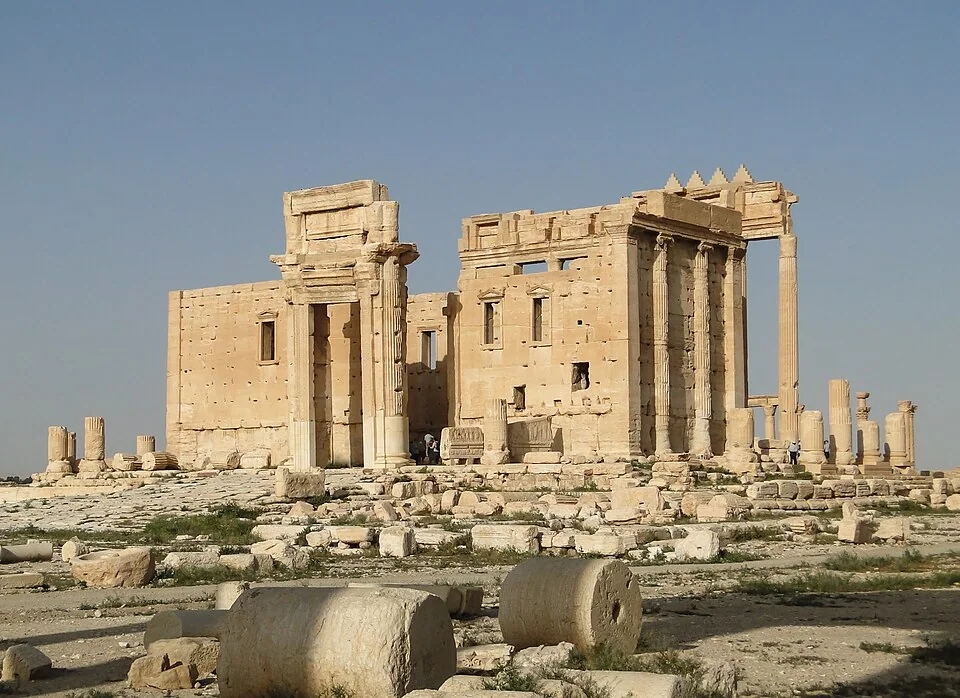
Bel was a major divine patron at Palmyra. His name and worship connect the city with Mesopotamian traditions, while the local cult developed its own setting and associations. Baalshamin, the Lord of the Heavens, was another major power; the resemblance between the names should not collapse the two into one deity.
Palmyrene religious life joined local, Mesopotamian, Syrian, Arabian, and Mediterranean elements. Temples and inscriptions express the city's position within caravan networks and the particular histories of the groups supporting a cult. French Ministry of Culture, gods of Palmyra.
Yarhibol, Aglibol, and Malakbel
Yarhibol has solar associations and a relationship with the Efqa spring. Aglibol is associated with the moon. Malakbel, whose name means messenger or angel of Bel, also developed solar imagery. Their combinations in images and dedications reflect particular cult relationships rather than one universally fixed divine family.
Nabu, Nergal, and other figures connect Palmyra with broader Near Eastern traditions. Shai al-Qaum, described in an inscription as a god who does not drink wine, illustrates the presence of powers associated with mobile groups and their distinctive commitments.
Ritual Meals and Community Membership
Palmyrene tesserae, small tokens often bearing divine imagery and inscriptions, are associated with ritual meals and participation. Their evidence links worship with organized groups, named individuals, and occasions of communal gathering.
Priestly office, clothing, banqueting, and donations made religious relationships publicly visible. A temple was not merely a building housing a statue: it was a setting in which social membership, status, and relations with divine patrons were maintained. Palmyra Archaeological Museum, worship and religion.
What Can Be Recovered
Inscriptions often establish that a deity was invoked or thanked without preserving a detailed mythology. Later identifications with Dionysus, Zeus, Athena, or other Mediterranean figures show translation between religious systems; they do not authorize importing every Greek story into Nabataean or Palmyrene belief.
The article on ancient South Arabian traditions addresses a different part of this broad history. Southern Arabian inscriptions, northern oasis cults, and the religious environment of western Arabia before Islam each require their own evidence.