The Picts were peoples and kingdoms of northern and eastern Scotland known from late Roman and early medieval sources. Their religious history includes traditions preceding Christianity and the development of powerful Christian institutions. “Pictish” does not identify a single unchanging religion throughout that period.

No surviving Pictish narrative collection provides a securely identifiable pantheon or complete creation story. A comprehensive account must therefore distinguish what objects and texts demonstrate from what modern interpretation proposes.
Symbol Stones and Their Meanings
Early symbol stones carry recurring signs, including animals, paired discs, crescents, rods, mirrors, and combs. Their repeated combinations suggest a structured means of communication, but the system has not been conclusively deciphered.
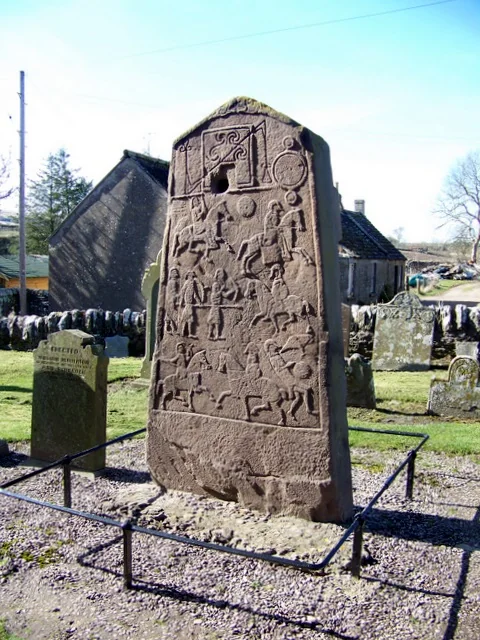
At the Picardy Symbol Stone, abstract signs belong to this early sculptural tradition. Later monuments combine inherited symbols with prominently Christian crosses. The sequence documents changes in public religious imagery without revealing exactly what every earlier sign meant. Historic Environment Scotland, Picardy Symbol Stone.
Symbols may concern names, identities, commemorations, or authority. Some could have religious associations, but calling each animal a god or every rod a magical weapon goes beyond the evidence. The Scottish Archaeological Research Framework explicitly notes uncertainty over their function. Pictish stone carvings.
The Pictish Beast
One especially distinctive creature is conventionally called the Pictish beast. Its elongated head, curling features, and unusual body have encouraged comparisons with marine animals and supernatural beings. No surviving inscription supplies an agreed name or story.
National Museums Scotland identifies it as part of the undeciphered symbol system. The name “Pictish beast” is therefore a modern descriptive label, not the recovered name of an ancient deity. Its repeated depiction shows cultural importance, but cannot tell us by itself whether it represented a being, a family identity, or another concept. National Museums Scotland, fantastic beasts.
Animals and Imported Religious Imagery
Pictish sculpture also includes recognizable animals, hunting, riders, and elaborate fantastic creatures. Some later motifs connect the monuments with a Christian artistic world extending well beyond Scotland. Mediterranean-derived forms could be adapted to local styles and political settings.
A hunting scene may celebrate elite activity or carry a more specific narrative meaning. Interpretation requires attention to the entire monument, its date, and its location. Isolating one figure and assigning it a universal meaning risks separating it from the context that made it intelligible.
Christianity and Continuity
Cross-slabs place Christian imagery alongside symbols inherited from earlier monuments. At Aberlemno, crosses and other carvings show that conversion did not entail the immediate disappearance of a distinct Pictish visual language. Local identity could remain visible within Christian forms of commemoration. Historic Environment Scotland, Aberlemno stones.
The Dyce stones similarly preserve evidence from different stages. An earlier symbol stone and a later Christian monument occur at a site associated with church use. This may indicate continuity of a significant place, although it does not establish the details of ceremonies conducted before Christianity. Historic Environment Scotland, Dyce stones.
Saints and Written Accounts
Christian writers describe missions, rulers, miracles, and confrontations with religious opponents. Such accounts are valuable for understanding how Christians remembered conversion, but miracle narratives are not neutral transcripts of earlier belief. Their purpose often includes demonstrating a saint's authority.
The Christian period provides firmer evidence for institutions, scriptural imagery, and commemorative practice than the earlier period provides for named gods. Monastic settlements and carved crosses place the Pictish kingdoms within networks of learning, patronage, and worship across Britain and Ireland.
The Limits of Reconstruction
It is possible to compare Pictish evidence with neighbouring Brittonic, Irish, and wider European traditions. Comparison can suggest questions, but it cannot supply missing Pictish names or prove that a familiar Irish or Welsh story was told in exactly the same form in a Pictish kingdom.
Modern accounts sometimes attach later Scottish water-horse legends to the Pictish beast or give it a specific divine identity. These proposals should be identified as interpretations. The surviving stones establish a sophisticated symbolic and religious culture while leaving many of its spoken narratives unrecoverable.