Phoenician religion developed in the cities of the eastern Mediterranean coast, particularly in what is now Lebanon, and in communities established around the Mediterranean. Tyre, Sidon, and Byblos did not share a single centrally governed pantheon. Their temples, divine patrons, and political institutions gave local form to related religious traditions.
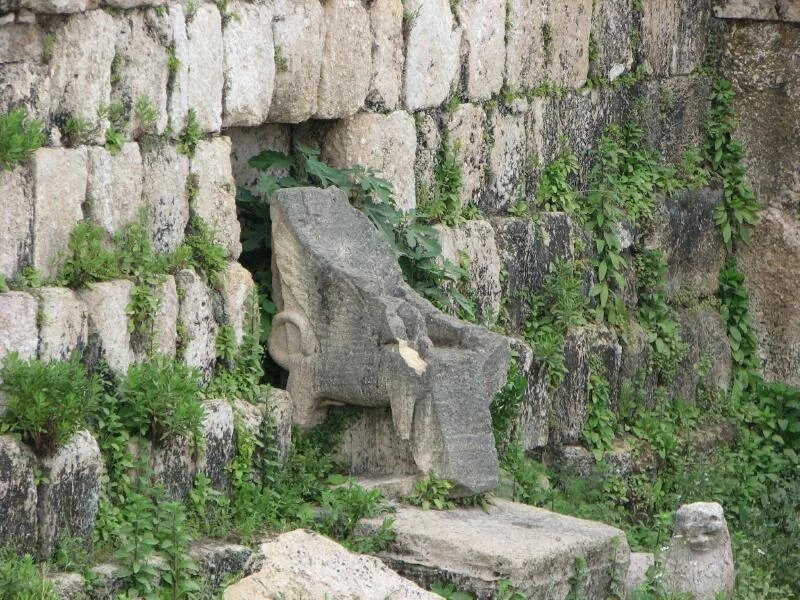

Much evidence comes from inscriptions, dedications, archaeology, and accounts written by outsiders. Long narrative texts are much less abundant than those surviving from Greece. The earlier texts of Ugarit illuminate a related Levantine setting, but they should not be presented as direct records of every later Phoenician belief.
Gods of the Cities
Melqart of Tyre
Melqart's name means “King of the City.” His importance joined the welfare of Tyre with royal authority and the city's relationships overseas. Greek writers identified him with Heracles, an interpretation that allowed comparison without making their histories identical.
His sanctuaries and worship travelled through Tyrian networks. Devotion to a city patron could therefore maintain a relationship with a homeland across considerable distances. Later accounts of death, renewal, and ceremonial awakening must be read in their particular textual contexts rather than expanded into a complete surviving Phoenician epic.
Astarte
Astarte was important at more than one Phoenician city and was associated with royal and divine power. Images and identifications connect her with sexuality, fertility, and martial authority, but the balance of these functions varies by place and period.
She is not simply interchangeable with every ancient Near Eastern goddess. Similar names and later Greek comparisons reflect historical relationships that require closer examination. At Tyre she appears beside Melqart, while at Sidon she is prominent alongside Eshmun. Italian National Research Council, “Religion of Phoenicia”.
Eshmun and Baalat Gubal
Eshmun was a major god of Sidon, particularly associated with healing. Votive offerings connected worshippers' bodily needs and gratitude with his sanctuary. Identification with the Greek Asklepios made his healing character intelligible across linguistic and religious boundaries.
Baalat Gubal, the Lady of Byblos, was the city's divine patron. Her title identifies a relationship with a place, not simply a universal office occupied identically throughout Phoenicia. Egyptian connections are visible in Byblian religious art and exchange, but imported imagery does not by itself demonstrate the replacement of a local goddess.
Titles, Protective Beings, and Divine Exchange
Baal means lord and can function as a title. A reference to a baal therefore needs its geographical or textual context before it can be assigned to one particular god. Likewise, Greek and Roman writers often explained foreign deities through their own divine names.
Protective imagery could cross cultural boundaries. Figures such as the Egyptian-derived Bes appear in Mediterranean contexts where people sought protection for domestic and bodily life. Phoenician religious practice included such intimate concerns alongside the great temples of the cities. Sa Caleta Museum, writing and religion.
Temples, Vows, and Offerings
A dedication records a relationship: a worshipper addresses a deity, asks for help, or acknowledges a favour. Inscriptions sometimes preserve the person's name and the reason for the gift. These records offer firmer evidence for particular acts than an attempt to reconstruct a detailed personality for every god from sparse references.
Offerings could include food, animals, valuables, and representations of worshippers. Temples were also economic and political institutions, with property, personnel, and connections to rulers. A religious festival could affirm civic membership as well as address a divine power.
Carthage and the Tophet Debate
Punic religion developed in the western Mediterranean, especially at Carthage. Baal Hammon and Tanit became prominent there. Tanit's familiar sign appears on many stelae, but its exact interpretation should not be assumed from its modern resemblance to a human figure.
Tophets contain cremated remains, including those of very young humans and animals, together with dedications. Ancient accusations of child sacrifice have been debated against archaeological and biological evidence. Research associated with Oxford argues that sacrifice did occur; other interpretations have emphasized infant mortality and disputed aspects of the evidence. The existence, scale, and circumstances of a practice should be distinguished rather than collapsed into either blanket denial or a claim that all children were sacrificed. Oxford University, research on Carthaginian sacrifice.
Myth and the Surviving Record
Later writers preserve accounts attributed to Phoenician authorities, notably material transmitted through Philo of Byblos and subsequent authors. Translation, interpretation, and the purposes of those writers affect what survives. Gaps should remain visible: inscriptions may securely establish a deity's worship without preserving the stories once told about that deity.