Persian mythology forms part of the wider Iranian world, while Zoroastrianism is a living religion with communities in Iran, South Asia, and elsewhere. The two categories overlap without being identical. Avestan hymns, Middle Persian religious books, royal inscriptions, and the later Persian Shahnameh belong to different periods and genres.
.jpg)
Ahura Mazda, Truth, and Choice
Ahura Mazda, the Wise Lord, is the source of good creation. Zarathustra's hymns, the Gathas, centre religious life on the choice between truth or right order, asha, and deceit, druj. Thought, speech, and action have consequences within this moral order.
Spenta Mainyu, the beneficent spirit, and Angra Mainyu, the destructive spirit, appear in a complex history of interpretation. Later Middle Persian texts describe Ohrmazd and Ahriman in a cosmic struggle bounded by time. It is misleading either to call Ahriman simply another equally worshipped god or to assume that every period expressed the conflict in exactly the same terms. Encyclopaedia Iranica, Ahura Mazda; Ahriman.
The Amesha Spentas
The Amesha Spentas express qualities of divine goodness and are associated with aspects of creation. Vohu Manah concerns good purpose or good mind; Asha Vahishta, the best truth or order; Khshathra Vairya, desirable dominion; Spenta Armaiti, devotion; Haurvatat, wholeness; and Ameretat, immortality.
Their relationships with animals, fire, metals, earth, water, and plants make care for the material world religiously significant. The world is not an evil prison to escape. Ritual brings these relationships together through substances such as water, plant offerings, metal implements, and fire. Describing the Amesha Spentas only as personifications loses their religious agency, while describing them as unrelated nature gods loses their unity with the good creation. Encyclopaedia Iranica, Amesha Spenta.
Yazatas and Their Characters
Mithra
Mithra guards agreements and watches for their violation. The Mihr Yasht presents him as vigilant, powerful, and difficult to deceive. His many eyes and ears express an awareness that reaches beyond ordinary human observation. His concern with contracts includes obligations between enemies: a promise is not disposable because the other party is disliked.
Although Mithra has solar associations, reducing him to the physical sun obscures his ethical and martial character. Roman Mithraic worship developed in a different setting and should not be treated as a transparent continuation of every Iranian teaching. Mihr Yasht, James Darmesteter's translation.
Anahita, Tishtrya, and Verethragna
Ardvi Sura Anahita is associated with the waters, purity, fertility, and the granting of strength or success. Heroes seek her favour, but divine assistance is connected with the character and purpose of the request.
Tishtrya, associated with Sirius, struggles against the drought power Apaosha. His victory brings the waters needed for life, and human worship supports the divine struggle. Verethragna embodies victory and appears in multiple forms, including powerful animals. These transformations express capacities rather than a single fixed bodily appearance.
Sraosha, Rashnu, and the Fravashis
Sraosha is associated with attentive obedience, ritual protection, and the care of the soul. Rashnu represents just judgment. The fravashis are protective spiritual presences connected with the righteous and with the safeguarding of creation; they are not simply interchangeable with a person's posthumous ghost. M. N. Dhalla, account of the Younger Avesta.
Yima, Dragons, and Iranian Heroes
Yima rules an age of abundance. One important Avestan narrative concerns the enclosure, or vara, in which selected forms of life are preserved from a destructive winter. Later traditions develop his story as Jamshid, whose achievements are followed by a disastrous loss of proper measure and royal glory.
Azhi Dahaka is a monstrous opponent associated with destructive power. In the later epic tradition he becomes Zahhak, the tyrant with serpents growing from his shoulders. Feridun overcomes him. These are related but historically distinct forms of a narrative, not interchangeable descriptions from one text.
The Shahnameh also gives a central place to Rostam and his family. Rostam's strength cannot prevent tragedy: he kills his son Sohrab without recognizing him. The Simurgh, a great bird who raises Rostam's father Zal and supplies crucial assistance, represents knowledge and care beyond ordinary human society. Encyclopaedia Iranica, Iranian myths and legends.
Judgment and the Renovation
After death, the soul encounters judgment connected with the Chinvat Bridge. Its passage reflects the moral quality of the life lived. Religious accounts give a concrete form to the consequences of thought, word, and deed rather than treating ethical action as irrelevant once a person dies.
The eventual renovation, frashokereti, brings the defeat of destructive power and the restoration of creation. Later accounts include resurrection, a final ordeal, and the removal of corruption. The world's future is consequently not an endless stalemate between equal forces: the good creation is to become free from its affliction.
Fire, Worship, and Purity
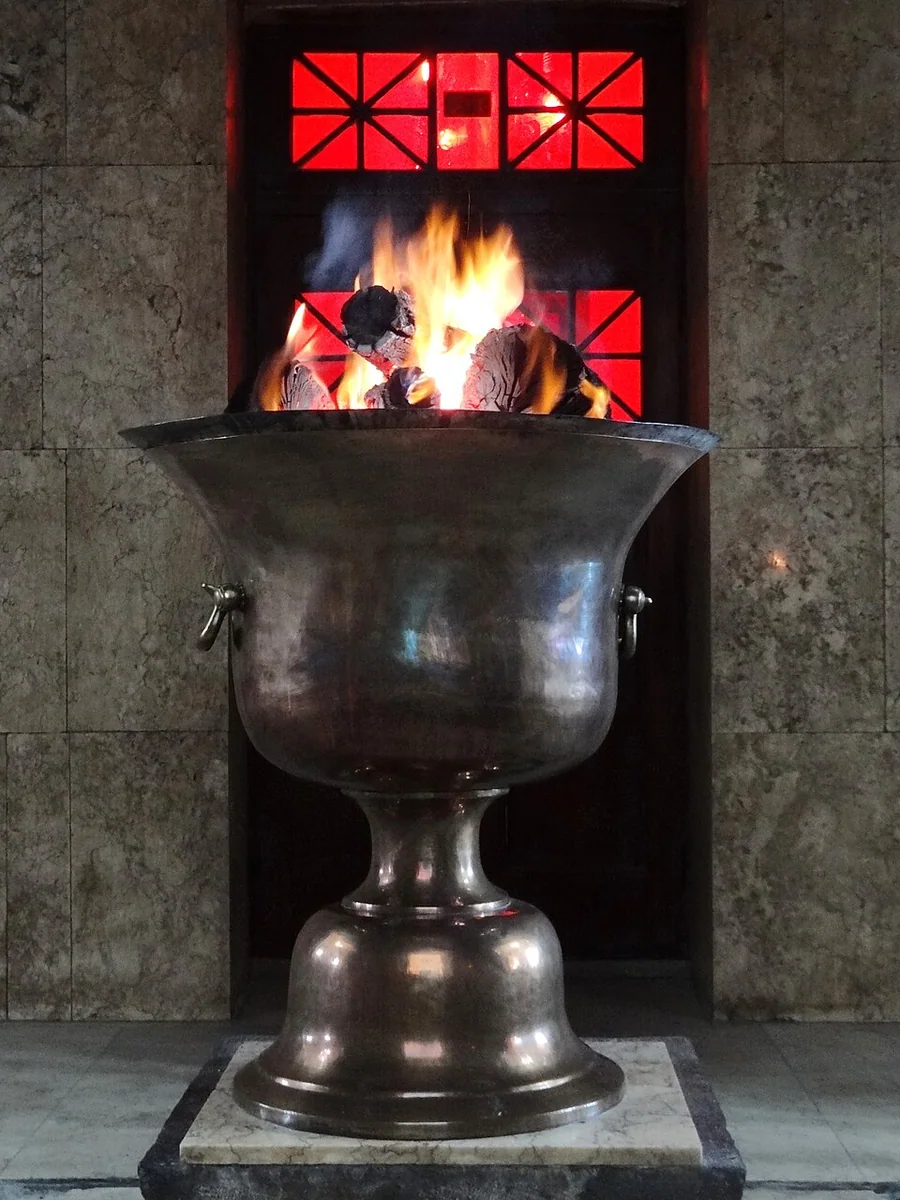
Fire is a major focus of worship because of its relationship with truth, life, and purity. Calling Zoroastrians “fire worshippers” can suggest that they mistake a flame for the entirety of God. Consecrated fire instead has a specific place within a wider religious order. The Yasna combines recitation with carefully arranged ritual actions and offerings. Yasna, translated in the Sacred Books of the East.
Initiation invests a person with the sacred shirt and cord, known among Parsis as the sudreh and kusti. Prayer and the tying of the cord reaffirm religious responsibility. Seasonal festivals and commemorations connect community life with the calendar.
Funerary customs historically sought to prevent corpse matter from contaminating earth, water, and fire. Exposure in designated structures was one response, but practice has varied across history and continues to change with local conditions. It should not be presented as the only form used by every Zoroastrian community. Encyclopaedia Iranica, Zoroastrian burial.