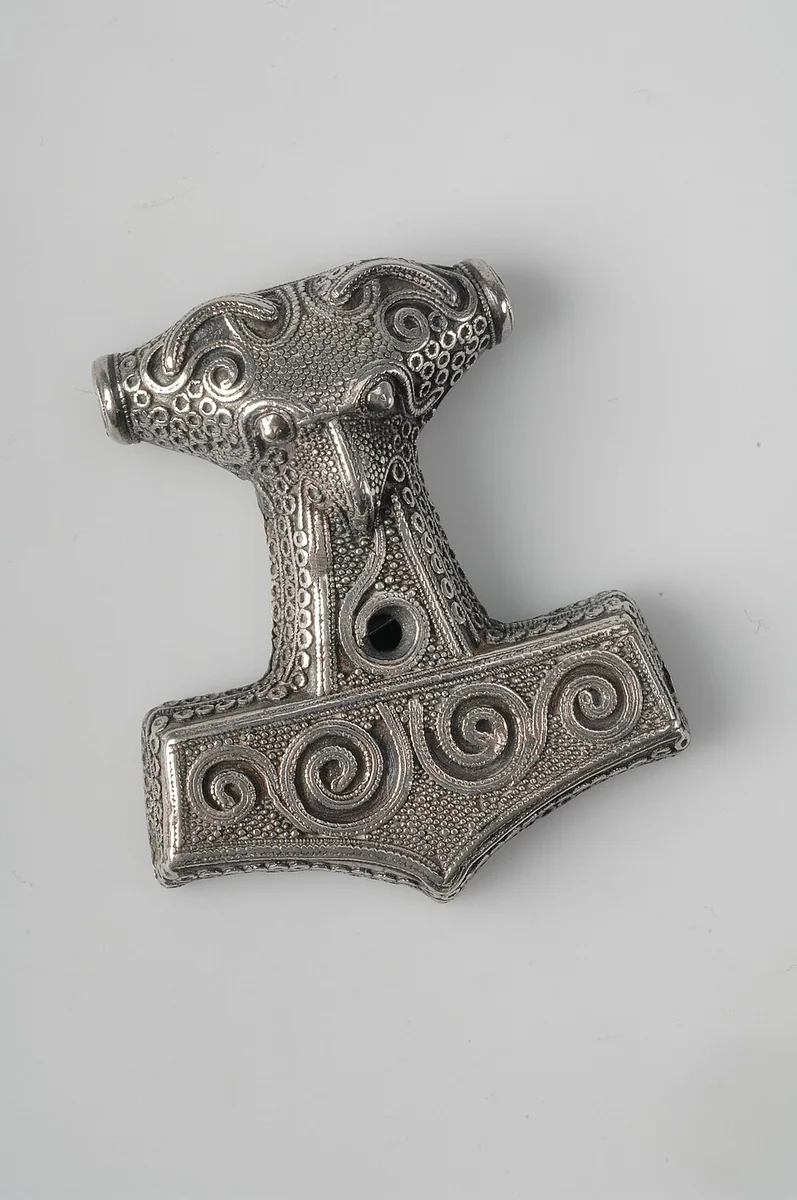
Norse mythology comprises traditions of the pre-Christian Scandinavian world and its settlements overseas. Its best-known written sources, the Poetic Edda and Snorri Sturluson's Prose Edda, survive in medieval Icelandic manuscripts produced after conversion to Christianity. Archaeology, place-names, and earlier poetry provide additional evidence. The surviving literature is not a scripture that every Viking-age community followed in the same way. National Museum of Denmark.
.jpg)
Creation and the Structure of the World
In Snorri's account, primordial cold and heat meet in Ginnungagap. From this encounter emerges Ymir, ancestor of the giants, while the cow Audhumla nourishes him and licks another ancestral being from salty ice. Odin and his brothers kill Ymir and make the world from his body: flesh becomes land, blood the sea, and the skull the sky.
The gods establish Midgard for humanity. Ask and Embla, the first human pair, receive the capacities necessary for life from divine beings. The world tree Yggdrasil connects different realms, but the familiar modern diagram of exactly nine neatly arranged worlds is more systematic than the surviving texts. Wells, roots, halls, and roads structure a geography of encounters rather than a consistently mapped universe. Snorri, Gylfaginning, translated by Arthur Gilchrist Brodeur (1916).
The Gods and Their Personalities
Odin
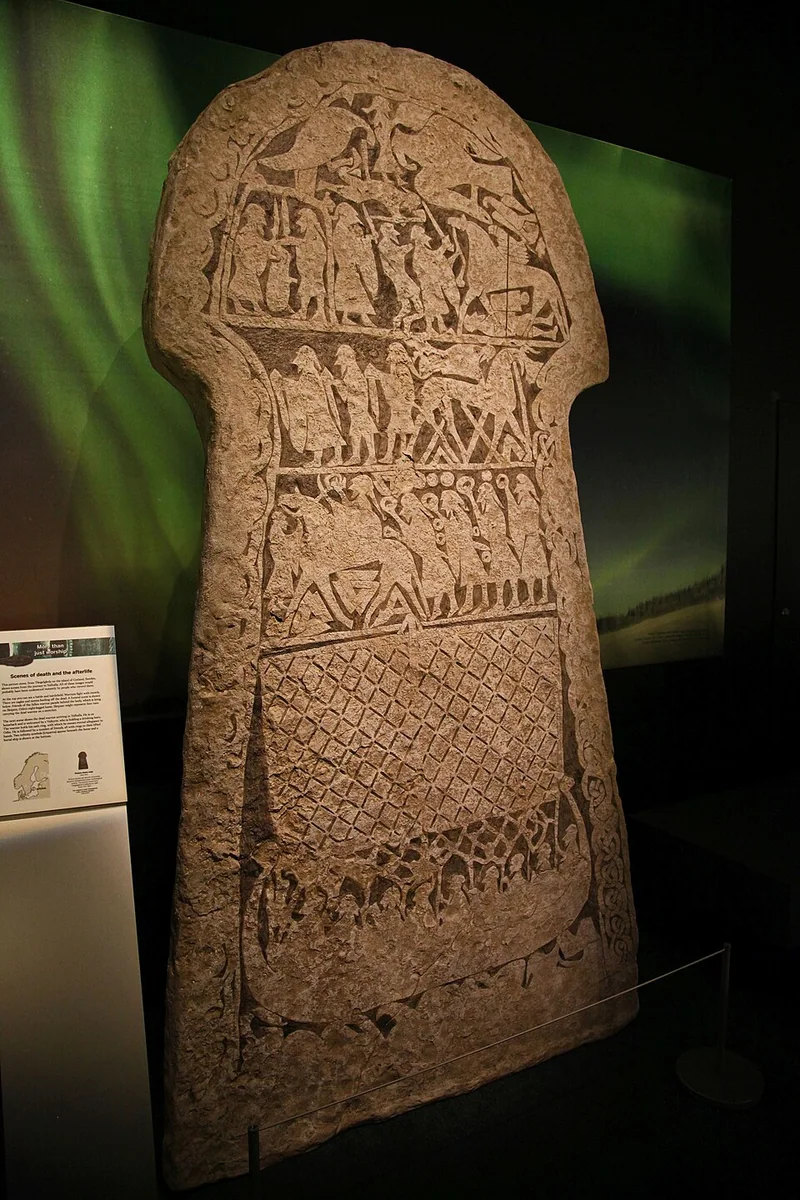
Odin pursues knowledge, poetry, victory, and power over the dead. He sacrifices an eye for wisdom and, in the poem Hávamál, hangs upon a tree in an ordeal through which he gains the runes. His raven companions Huginn and Muninn gather information. His spear Gungnir and eight-legged horse Sleipnir mark his supernatural authority.
His intelligence is dangerous. He can grant victory and withdraw it, provoke conflict, disguise himself, and manipulate those he encounters. His collection of slain warriors prepares for a catastrophe that knowledge cannot entirely avert.
_MuseumsPartner_exhibition_%22Vikings_Beyond_the_legend%22_Australian_National_Maritime_Museum_Sydney_2013.jpg)
Thor
Thor defends gods and humans against threatening giants. His hammer Mjöllnir returns when thrown and can consecrate as well as destroy. His strength is paired with directness, appetite, and occasional embarrassment. In one poem he disguises himself as a bride to recover the stolen hammer; in another narrative, contests at Útgarða-Loki expose the limits of brute force when appearances conceal cosmic realities.
Thor's fishing expedition brings him into confrontation with Jörmungandr, the serpent surrounding the inhabited world. Their rivalry culminates at Ragnarök.
Freyja, Freyr, and Njord
Freyja is associated with desire, precious objects, and seiðr, a form of magic. She also receives a share of those killed in battle, complicating the assumption that every honoured warrior goes to Odin. Her necklace Brísingamen is a celebrated possession.
Her brother Freyr is connected with prosperity, fertility, and peace. His desire for the giantess Gerðr drives a story of negotiation and coercion, rather than an uncomplicated romance. Njord, their father, is associated with maritime wealth and favourable conditions at sea. His marriage to the mountain-associated Skaði dramatizes incompatible ways of living.
Frigg, Baldr, Tyr, and Heimdall
Frigg seeks protection for her son Baldr by obtaining promises that things will not harm him. Mistletoe is overlooked; Loki exploits the omission and directs the blind Höðr toward the fatal act. An attempted recovery from the realm of the dead fails when universal mourning is not achieved.
Tyr places his hand in Fenrir's mouth as a pledge while the gods bind the wolf. When the deception becomes clear, he loses the hand. His courage thus appears within a story in which the gods themselves break trust. Heimdall guards the divine realm and sounds the warning at the final crisis.
Loki
Loki is a mobile, resourceful, and disruptive figure whose relationship with the gods changes across stories. He causes problems and devises solutions, sometimes obtaining the gods' most important possessions. His transformations cross boundaries of sex and species; as a mare, he gives birth to Sleipnir.
His offspring with Angrboða include Fenrir, Jörmungandr, and Hel. His involvement in Baldr's death leads to binding and punishment. Calling him simply a “god of evil” obscures both his earlier usefulness and the narrative tensions surrounding his place among the gods.
Giants, Dwarfs, Elves, and Fate
The jötnar, conventionally translated as giants, are not uniformly enormous or stupid. They include ancestors, opponents, spouses, and possessors of knowledge. Divine society depends on relationships with them even while defending its boundaries.
Dwarfs make extraordinary objects, including weapons and treasures that shape divine events. Elves are less fully described in the surviving literature than modern fantasy suggests. The norns, including Urðr, Verðandi, and Skuld, are associated with the allotment of lives and destiny. Valkyries select the slain and serve Odin, while other female powers appear in family protection and fate traditions.
Ragnarök and Renewal
Ragnarök brings social breakdown, the release of bound enemies, and a battle the gods cannot simply win. Fenrir kills Odin and is killed by Odin's son Víðarr. Thor kills Jörmungandr but dies from its venom. Fire and inundation destroy the familiar world.
Yet the narrative also describes renewed land, returning or surviving gods, and a human pair from whom life continues. The relationship between destruction and renewal differs among texts, and scholars debate how Christian ideas affected their surviving forms. The gods' mortality remains central: divine power does not remove vulnerability.
Worship, Sacrifice, and the Dead
Blót involved offerings, feasting, and relationships between communities and supernatural powers. Worship could take place at halls, outdoor sites, and specialized cult buildings. Amulets, deposited objects, and burials provide evidence beyond the literary descriptions, although an excavated object rarely explains its own ritual meaning.
Valhalla was one destination of the dead, not a universal Norse heaven. Other traditions concern Hel, family burial places, sea-associated deaths, and continued relations with the dead. Modern Heathen and Ásatrú communities draw on these sources in diverse ways; their organized practices should be distinguished from evidence for Viking-age observance. National Museum of Denmark, modern Nordic religion.