The Banyankore, also written Banyankole, are associated with the historical kingdom of Nkore, later called Ankole, in southwestern Uganda. Their traditions developed among communities engaged in cattle keeping and cultivation. Older sources often describe Bahima pastoralists and Bairu cultivators as sharply separated categories; those accounts also reflect political hierarchies and the assumptions of colonial observers.

Religion historically concerned creation, the welfare of households, the protection of cattle and crops, the authority of rulers, and relations with spirits. Contemporary Banyankore include Christians and people with varied relationships to inherited practices. Historical beliefs should not be assigned indiscriminately to the present population.
Ruhanga and the Created World
Ruhanga is the creator, understood as the maker and giver of life. In accounts preserved by the Banyankole Community, his dwelling is above the clouds. His creative authority differs from the more immediate activity of spirits approached over illness or household misfortune.
This distinction matters when describing the religion. Ruhanga need not be imagined as the head of a Greek-style family of gods, each with a fixed sphere of responsibility. Names, praise expressions, and titles for divine power are also not automatically evidence for separate deities. Banyankole Community, history and traditions.
Emandwa and Spirit Relationships
Emandwa are spirits associated with particular families or clans. Recorded observances include keeping shrines and presenting portions of food or drink. Okubandwa refers to ritual activity through which people establish or renew relations with such powers, including in response to misfortune.
Related spirit traditions extend across the Great Lakes region, but the names and histories of spirits vary. It would be misleading to import every Cwezi figure known from neighbouring kingdoms into a universal Nkore pantheon. A spirit's importance may arise from its relationship to a family, locality, or line of ritual specialists rather than from a single narrative recognized everywhere.
Sacred Kingship and the Royal Drums
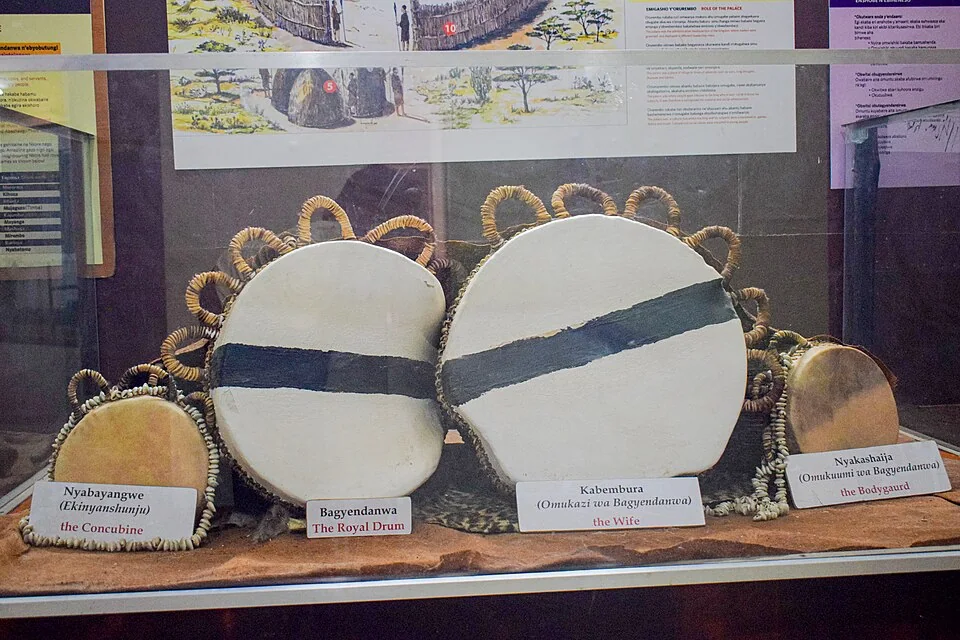
The omugabe, or king, occupied a position surrounded by restrictions and ritual duties. Royal objects represented the continuity of authority beyond the life of an individual ruler. Regalia and drums were treated with a seriousness that exceeded their practical uses in communication or ceremony.
John Roscoe's early twentieth-century account devotes substantial attention to royal institutions, including the ruler's household and the handling of royal drums. It records practices at a particular historical moment and relies heavily on elite informants. Its descriptions are useful evidence, but its language about “races,” social ranks, and religious development should not be accepted as neutral analysis. Roscoe, The Banyankole (1923).
Cattle, Fertility, and Everyday Observance
Cattle were sources of food, wealth, social relationships, and valued forms of beauty. Their care involved rules governing milk, vessels, and the work of the household. Where ritual restrictions surrounded milk, the issue was not simply hygiene: the prosperity and continuity of the herd also had religious and social dimensions.
Agricultural households depended on rainfall and the successful reproduction of crops and people. Illness, infertility, or repeated loss could prompt consultation with specialists and attention to neglected obligations. These explanations existed alongside practical knowledge of animal care and cultivation; religious causation did not eliminate ordinary observation.
Animal Tales and Moral Reasoning
Hare is a prominent figure in oral storytelling. His intelligence can overcome stronger animals, but cleverness is not necessarily admirable. A tale preserved by the Banyankole Community recounts how Hare deceives Leopard into killing an innocent Fox. The story exposes both manipulation and the danger of acting without investigating an accusation.
Such narratives should be distinguished from accounts of gods. An animal protagonist may teach listeners how deception, trust, or authority works without receiving worship. Performance, context, and the teller's interpretation shape the lesson; a single written version does not exhaust a tale's meanings.
Ancestors, Death, and Transmission
Death affected the household's future through inheritance, remembrance, and the redistribution of responsibilities. Historical accounts of illness and burial describe concern with the continuing consequences of relationships between living and dead. Practices differed by status and locality, making generalized statements about a single afterlife scheme unreliable.
Oral genres—including praise poetry, proverbs, family histories, and animal tales—preserve religious vocabulary and ideas even where formal worship has changed. Studying these genres alongside community accounts helps distinguish remembered customs from current observance and political history from mythic narrative.