The Nivkh are an Indigenous people of the lower Amur River and Sakhalin. Fishing, hunting, and relationships among clans historically shaped their religious life. Local traditions differ, and descriptions collected before and during Soviet rule record particular communities rather than a single timeless system. The older ethnographic name “Gilyak” appears in many sources but is not the preferred name here.

A World of Spirit Masters
Nivkh accounts describe mountains, rivers, and the sea as domains of powerful masters, often transcribed yz or yzng. These beings provide the animals on which human life depends. Hunting and fishing consequently involve obligations to the beings responsible for those animals, as well as practical skill.
Treatment of remains matters. Disrespect toward fish can offend the sea master and jeopardize later catches. Such practices express a relationship in which humans receive food from persons or powers beyond the human community. They do not require a single creator with a fixed biography or a centrally organized pantheon. Yale eHRAF, Nivkh cultural summary.
The Bear and Its Return
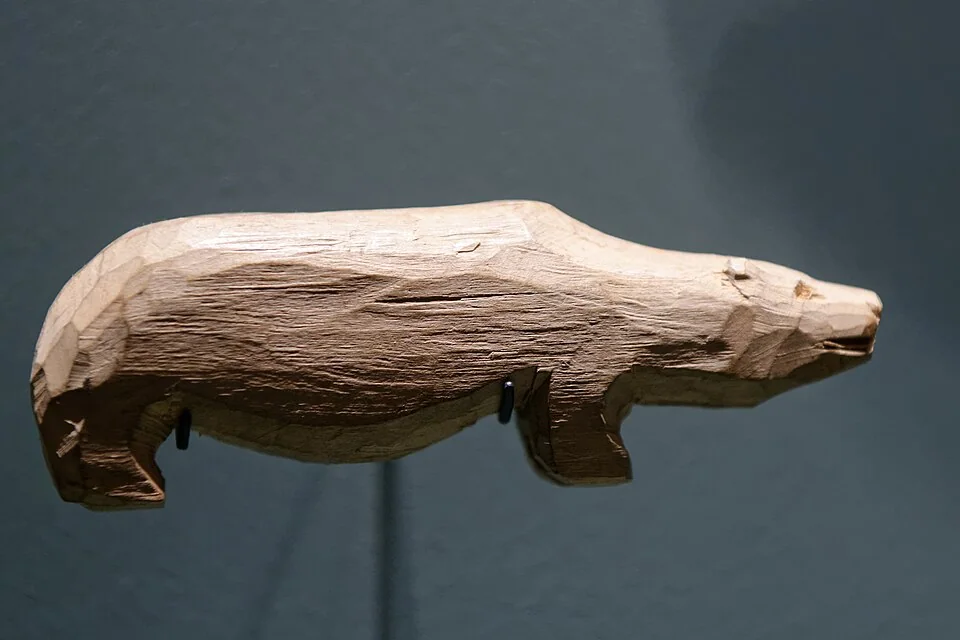
The bear has a particularly important place in relations between people and the mountain forest. In historically recorded ceremonies, a cub was raised within a community before a festival at which it was ritually killed. The ceremony addressed the bear as a significant visitor whose departure could renew relations with the nonhuman world.
The Russian Museum of Ethnography describes the bear's soul as returning with gifts to the mountain-taiga master. The animal mediated between a particular clan and the source of game. Feeding and honouring the bear were therefore connected to its eventual return, not evidence that participants alternated arbitrarily between affection and hostility.
The festival also involved relations among human groups. Hosting, distributing food, and participating in ritual affirmed responsibilities extending beyond an individual household. Its meaning cannot be reduced to “bear worship,” a label that conceals the exchange, mourning, kinship, and subsistence relationships involved. Russian Museum of Ethnography, Nivkhi and Uilta.
Fire, Offerings, and Household Protection
Fire occupied a special position in the household and clan. Recorded practices include feeding it small offerings and treating it respectfully. The hearth linked everyday domestic life with protective powers and with relations inherited from earlier generations.
Water and the sea could also receive offerings. These actions sought safe travel and favourable relations with the beings of a place. They should be understood within particular occasions and communities; a brief list of gifts cannot describe all Nivkh ritual practice.
Nivkh traditions are related through historical contact to those of neighbouring peoples, including the Uilta and Ainu. Similarities in bear ceremonies do not make these peoples interchangeable. Museum research distinguishes the objects, participants, and procedures of the different communities. Tatiana Sem, study of Nivkh and Uilta bear ceremonial collections.
Stories, Transformations, and the Landscape
Narratives give animals capacities that ordinary observation alone does not reveal. Transformations between human and animal forms make the boundary between kinds of beings negotiable. These stories concern relations, obligations, and encounters; their protagonists need not belong to a fixed catalogue of gods.
Sakhalin itself can be imagined as a living body. Accounts that associate geographical features with parts of an immense being make the landscape intelligible through bodily experience. Other narratives explain transformations of land and water. Recorded variants should remain distinct rather than being combined into a single official creation story.
Healing and Religious Change
Shamans historically diagnosed illness and negotiated with otherworldly beings. Healing could involve recovering or protecting a person's vital condition and addressing the spirit relations implicated in suffering. The shaman's role was specialized: household offerings and the bear ceremony were not simply interchangeable examples of shamanic performance.
Russian Orthodox missionization, Soviet restrictions on religious activity, settlement changes, and the disruption of fishing and hunting economies altered the transmission of these practices. Baptism did not necessarily entail abandoning inherited understandings. Contemporary cultural work includes language, storytelling, and the preservation or interpretation of ceremonial knowledge. Historical accounts should therefore be read as records of changing practices, not as descriptions of what every Nivkh person believes today.