The Newar people are the historical inhabitants of Nepal's Kathmandu Valley and speakers of Nepal Bhasa. Their religious life includes Hindu, Buddhist, and local traditions whose institutions frequently overlap. A shared festival or shrine does not make their teachings identical: a Buddhist Vajracharya priest, a Hindu temple priest, and a household worshipper can understand the same sacred figure differently. Family, locality, caste, and initiation shape access to particular practices.

The Sacred Valley
The Svayambhu Purana describes the valley as a lake containing a luminous lotus, a spontaneous manifestation of awakening. Manjushri, the bodhisattva of wisdom, makes this holy place accessible by draining the lake. The narrative explains both the habitable valley and the sanctity of Svayambhu, whose chaitya encloses the self-manifested presence. It connects spiritual insight with the making of a human landscape.
Svayambhu's imagery also expresses a Buddhist mandala. Akshobhya, Ratnasambhava, Amitabha, Amoghasiddhi, and Vairochana embody different aspects of awakened understanding. These buddhas are not rival creator gods: their arrangement makes a sacred order available to meditation and worship. Alexander von Rospatt, Rubin Museum.
Deities, Bodhisattvas, and Divine Presence
Bunga Dya and Karunamaya
Bunga Dya, also called Bunga Lokeshvara, Karunamaya, and Rato Macchendranath, joins several histories of worship. Newar Buddhists identify him with Avalokiteshvara, whose defining quality is compassion. His association with rainfall makes him particularly important to farmers. Hindu interpretations connect him with the yogi Matsyendranath.
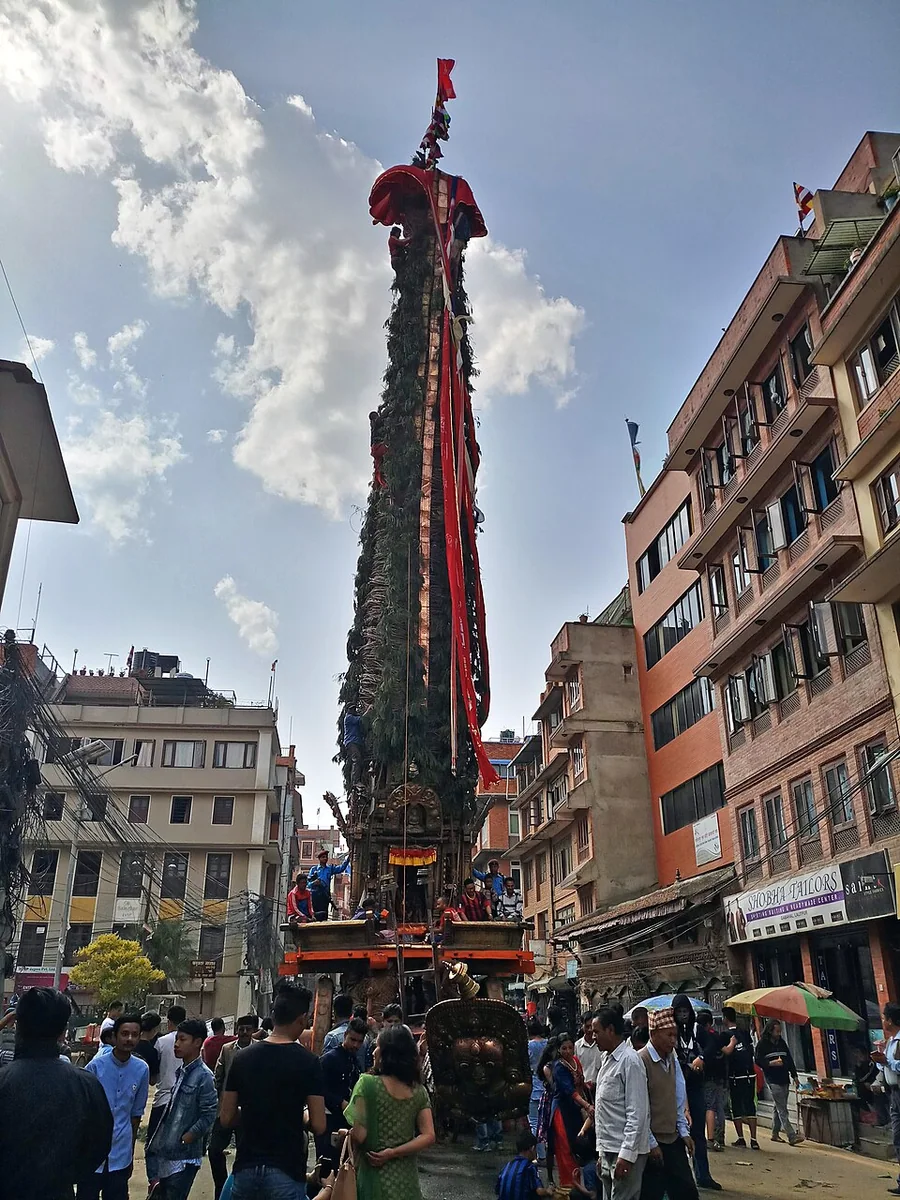
His sacred image moves between Bungamati and Patan, and his chariot procession requires extensive cooperation among local communities. The deity's presence is attached to a particular image and its movements, not just an abstract name. Stories of his arrival explain the restoration of rain and the establishment of his worship. These identifications developed historically; they should not be treated as interchangeable from the beginning. Ian Alsop, Rubin Museum.
Taleju and the Kumari
Taleju was a protective goddess of the Malla rulers. Her power connects political authority with the wider South Asian traditions of the Goddess. Newar goddess worship includes both nurturing and formidable forms: protection may require confronting disease, disorder, or hostile beings.
The Kumari institution locates divine presence in a living girl. Girls selected from particular Newar Buddhist communities receive worship from Hindu and Buddhist devotees. Their ritual role is temporary, with selection and retirement governed by local traditions. Kathmandu's royal Kumari is the best-known example, but other towns maintain their own institutions. The Kumari is a person occupying a sacred office, not simply a theatrical portrayal of a goddess. Rubin Museum, ritual necklace and Kumari traditions.
Protective and Wrathful Forms
Bhairava, a fierce form of Shiva, and the Mother Goddesses are prominent in Newar sacred geography. Their threatening appearance expresses the ability to contain dangers that gentler forms cannot overcome. Tantric worship may distinguish public celebrations from practices restricted to initiated participants.
Siddhi Lakshmi is one such powerful goddess. Associated with royal protection and with Taleju, she exemplifies the importance of shakti, divine power understood in feminine form. Images and temples situated her worship within the competing royal cities of the valley. Her iconography is therefore religious and political, rather than evidence for a simple division between benevolent and evil gods. Kerry Lucinda Brown, Rubin Museum.
Serpents, Water, and Sacred Images
Nagas are serpent beings associated with water, fertility, and the protection of sacred places. Their presence in the valley's narratives recalls its imagined lake origins and the continuing dependence of urban and agricultural life on water. A naga is not equivalent to a European dragon: the category includes guardians and beings whose anger requires ritual attention.
Consecrated images likewise have an active role. Dressing, bathing, repairing, and carrying a deity can sustain relationships between the deity and worshippers. A procession temporarily extends the temple into streets and neighbourhoods; the route itself expresses relationships among communities.
Priests, Households, and Festivals
Newar Buddhism preserved Sanskrit texts and elaborate Mahayana and Vajrayana practices. Vajracharyas serve as hereditary tantric ritual specialists, while Shakya communities are associated with the maintenance of monastic institutions. These institutions developed forms of religious life involving married householders, complicating the assumption that all Buddhist religious authority must be exercised by celibate monks. Newar communities also participate in Theravada and Tibetan Buddhist traditions.
Daily offerings coexist with large festivals, pilgrimage, initiation, and life-cycle observances. Religious associations and neighbourhood groups provide the labour and resources needed for processions and shrine maintenance. Participation can involve drumming, preparing offerings, financing repairs, or pulling a chariot, as well as prayer.
Seasonal festivals connect rain, agricultural work, and the welfare of the city. Bunga Dya's procession is a particularly clear example: Buddhist officiants conduct rites for a deity honoured across religious boundaries. The Nepal Tourism Board describes the chariot's preparation and installation as integral parts of this annual observance. Ratharohan of Rato Machindranath.